
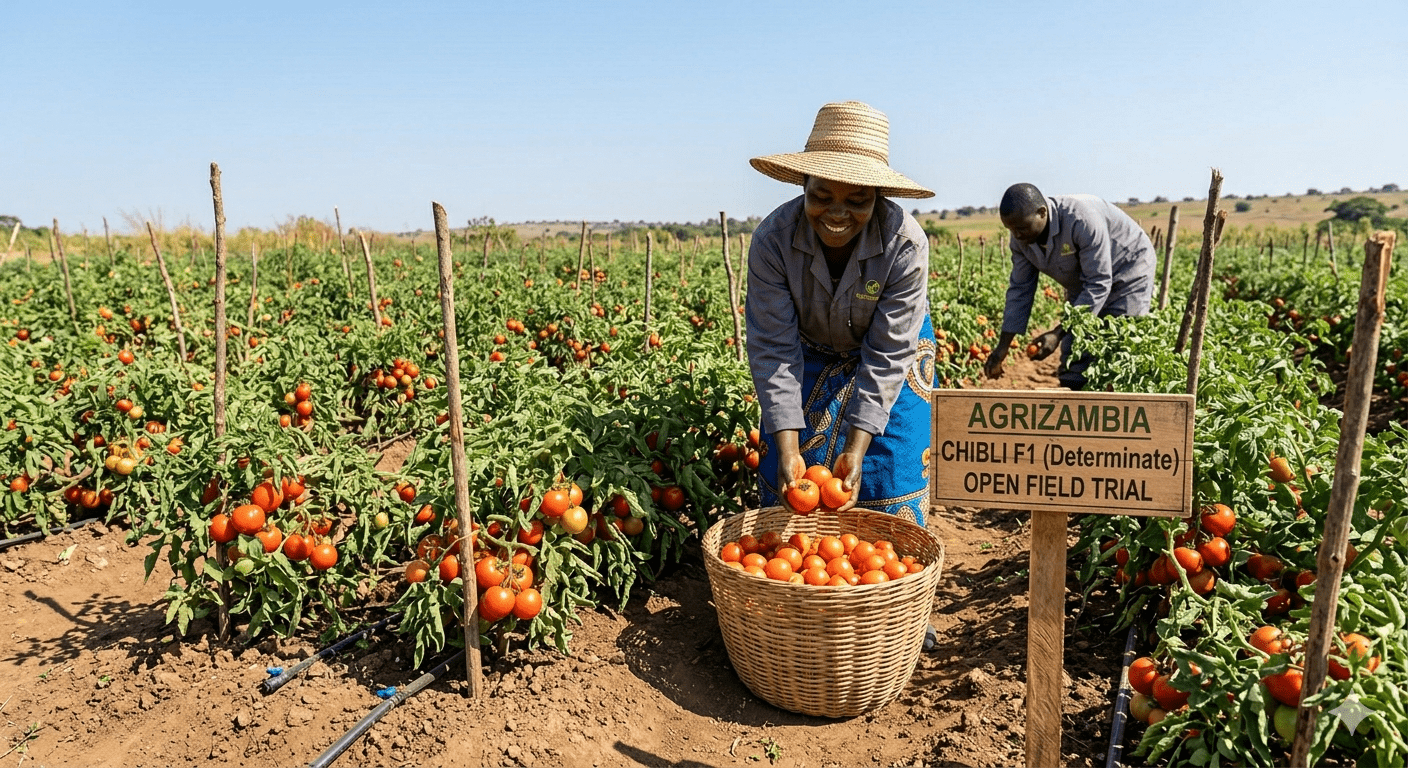
Tomato production is one of the most profitable open-field and greenhouse ventures in Zambian horticulture. However, success depends heavily on selecting the correct variety for your specific market, production setup, and seasonal window. Choosing a variety with poor disease resistance or soft skin can result in heavy field losses or transport damage before your crates even reach busy markets like Soweto in Lusaka or the Copperbelt.
This support guide breaks down the top-performing tomato hybrid (F1) and open-pollinated (OPV) varieties available in Zambia, categorizing them by growth habits and commercial advantages.
1. Understanding Tomato Growth Habits
Before buying seed packets from suppliers like Seed Co, Syngenta, or Starke Ayres, you must understand the two main plant growth habits:
- Determinate (Bush Varieties): These plants grow to a fixed compact size, set fruit all at once, and harvest over a short, concentrated window (usually 2 to 3 weeks). They do not require extensive trellising or pruning, making them cheaper to manage in open fields.
- Indeterminate (Vine Varieties): These plants continue growing and producing clusters of fruit indefinitely as long as the weather and management allow. They require robust staking, trellising, and regular pruning, making them ideal for high-yielding greenhouses or long-term open-field structures.

2. Top Indeterminate (Vine) Tomato Varieties in Zambia
Indeterminate hybrids are the gold standard for growers looking for sustained, massive yields over several months.
Tomato Alambra F1 (Seed Co)
- Maturity: 75 to 85 days after transplanting.
- Yield Potential: Up to 160 metric tons per hectare in open fields, and up to 300 metric tons per hectare under greenhouse management.
- Fruit Characteristics: Large, smooth, globe-shaped, bright red fruits weighing 160g to 180g. They are exceptionally firm, show great resistance to fruit cracking, and carry an excellent shelf life of up to 14 days.
- Best For: Farmers targeting urban wholesale markets where fruit size uniformity and long-distance transport stability are vital.
Trinity F1 (Starke Ayres)
- Maturity: Medium maturing; in summer plantings, the first fruit matures in 80 to 85 days after transplanting.
- Yield Potential: Very high yield potential with sustained, multi-truss setting that maintains uniform size all the way to the top of the plant.
- Fruit Characteristics: Oblate to deep oblate fruits with an average mass of 140g to 160g. It is a jointed variety featuring a very long shelf life and thick, firm walls.
- Key Advantage: It features a stellar, broad disease resistance package, combining multi-virus and strong bacterial resistances (High Resistance to Verticillium Wilt, Fusarium Wilt, TMV, and TYLCV).
- Best For: Open field or greenhouse trellising for fresh markets where high-percentage first-grade fruit and crop longevity are needed.
Tovi Star F1 (Syngenta)
- Maturity: 75 to 85 days after transplanting.
- Yield Potential: Over 150 tons per hectare under good agricultural practices.
- Fruit Characteristics: Delivers an impressive shelf life of over 10 days, making it highly suitable for long-distance regional transport without bruising.
- Key Advantage: A very high-vigor hybrid backed by a strong disease resistance package, including intermediate tolerance to Tomato Mosaic Virus, Fusarium Oxysporum, and Tomato Yellow Leaf Curl Virus.
- Best For: Open field open-ended cropping where intense disease pressure usually limits smallholder yields.
Newton F1 (Syngenta)
- Maturity: 75 to 85 days after transplanting.
- Yield Potential: 120 to 150 tons per hectare under optimal conditions.
- Fruit Characteristics: Large, firm, jointed round fruits (>160 grams) with deep red color at maturity and no green shoulders. It has excellent resistance to both macro and micro shoulder cracking, even during periods of heavy rain and high humidity.
- Key Advantage: Highly adaptable to all growing areas with a vigorous, healthy growth habit and strong tolerance against Fusarium crown/root rot and Grey Leaf Spot.
- Best For: Open field production during erratic weather windows or high-moisture rainy seasons where fruit cracking ruins market value.
Canova F1 (Seed Co)
- Maturity: Medium to early.
- Yield Potential: Extremely high with consistent fruit setting throughout the season.
- Fruit Characteristics: Uniform, firm, blocky-round fruits with a highly attractive, deep red color that appeals strongly to local buyers.
- Best For: Premium open-field trellising and protected greenhouse structures where long shelf life and transport resilience are required for strict supply chains.
3. Top Determinate (Bush) Tomato Varieties in Zambia
Determinate hybrids are preferred for lower-cost setup fields, processing markets, or concentrated seasonal windows.
Chibli F1 (Syngenta)
- Maturity: 75 to 85 days after transplanting.
- Yield Potential: 75 to 80 tons per hectare.
- Fruit Characteristics: Medium-sized, blocky-round fruits with excellent firmness and a 10-day shelf life.
- Key Advantage: Known for exceptional fruit-setting capabilities under hot conditions. The plant has high vigor and excellent leaf cover, which protects the developing clusters from sun scorch. It also demonstrates strength against Bacterial Leaf Spot.
- Best For: Open-field cultivation during hot rainy and post-rainy windows where leaf diseases and intense heat slow down other varieties.
Daisy F1 (Seed Co)
- Maturity: Early to medium.
- Fruit Characteristics: Highly firm round fruits built to withstand rigorous transport.
- Key Advantage: A sturdy, vigorous bush variety featuring very dense foliage cover. This heavy leaf canopy is critical during peak summer months to eliminate sun scald on the fruit.
- Best For: Low-maintenance open-field production where staking resources are limited.
4. Open-Pollinated Varieties (OPVs): The Low-Budget Option
While hybrid (F1) seeds offer superior yields and disease resistance, Open-Pollinated Varieties (OPVs) remain highly popular among small-scale farmers due to cheap initial seed costs.
Tomato Tengeru 97
- Characteristics: An indeterminate OPV selected for its extreme hardiness, immense vegetative growth, and large, broad leaves.
- Advantage: While it lacks the uniform size and massive yield ceilings of modern F1 hybrids, it is highly resilient, adapts easily to varied soil conditions, and the seeds can be saved and replanted for subsequent cycles.
5. Summary Matrix: Tomato Selection Tool
| Variety | Growth Type | Est. Yield (MT/Ha) | Key Strengths | Best Target Market |
| Alambra F1 | Indeterminate | 160 – 300 | Crack-resistant, 14-day shelf life, huge greenhouse yields | High-end wholesale & export |
| Trinity F1 | Indeterminate | High Potential | Multi-virus & strong bacterial resistance, uniform fruit size | Fresh retail & long-harvest markets |
| Tovi Star F1 | Indeterminate | >150 | Strong vigor, robust disease package, 10+ day shelf life | Long-distance regional shipping |
| Newton F1 | Indeterminate | 120 – 150 | Anti-cracking in heavy rains, robust root-rot package | Open field rainy season cropping |
| Canova F1 | Indeterminate | High Potential | Deep red color, high vigor, long-distance transport resilience | Supermarkets & urban wholesale |
| Chibli F1 | Determinate | 75 – 80 | Superb hot weather fruit setting, bacterial leaf spot strength | Open field rainy/summer crop |
| Daisy F1 | Determinate | Medium-High | Excellent leaf canopy cover to prevent sun scorch | Budget open field crop |
| Tengeru 97 | Indeterminate | Low-Medium | Very cheap seed cost, highly rustic and physically hardy | Local community supply |
6. Essential Management Tips for Zambian Tomato Farming
Regardless of the variety you pick, maximize your return on seed investment by adhering to these regional practices:
- Soil and pH Preparation: Tomatoes require deep, well-drained soils with a pH range of 6.0 to 7.5. Incorporate well-decomposed manure weeks before transplanting to boost organic content and moisture retention.
- Irrigation Discipline: Overhead irrigation wetting the leaves heavily promotes fungal blights (Early and Late Blight). Utilize drip irrigation wherever possible to deliver targeted water directly to the root zone while keeping the crop canopy dry.
- Disease and Pest Safeguards: Modern hybrids carry built-in genetic tolerances to regional challenges like Tomato Mosaic Virus (TMV) and Fusarium wilts. However, scout your fields daily for Tuta absoluta (Tomato Leaf Miner) and Red Spider Mites, which can decimate an unprotected crop within days. Ensure a strict chemical rotation or netting framework is established early.
Conclusion
Selecting the right tomato variety is the first and most critical step toward running a highly profitable commercial horticulture operation in Zambia. Whether you invest in the massive yield ceilings of modern indeterminate hybrids like Alambra F1 for greenhouse production, or opt for the heat-tolerant, low-maintenance open-field capabilities of determinate options like Chibli F1, aligning your seed choice with your management system ensures you maximize field returns and satisfy demanding market buyers.
However, masterfully selecting your tomato seed is only one piece of a successful seasonal strategy. To explore how to integrate high-value vegetable production into a diversified, year-round commercial layout—including optimal crop rotation cycles, soil fertility management, and broadscale irrigation planning—read our comprehensive guide on Commercial Crop Farming in Zambia.