

While aquaculture is undeniably one of the most lucrative agribusinesses in Zambia today, entering the market requires a clear understanding of both upfront capital and ongoing operational costs. Miscalculating your expenses—especially feed requirements—is the number one reason starter farms fail.
This support guide breaks down the real-world costs of starting and running a small-to-medium-scale fish farming business in Zambia, ensuring your venture remains fully budgeted from day one.
1. Capital Expenditure (CAPEX): Upfront Startup Costs
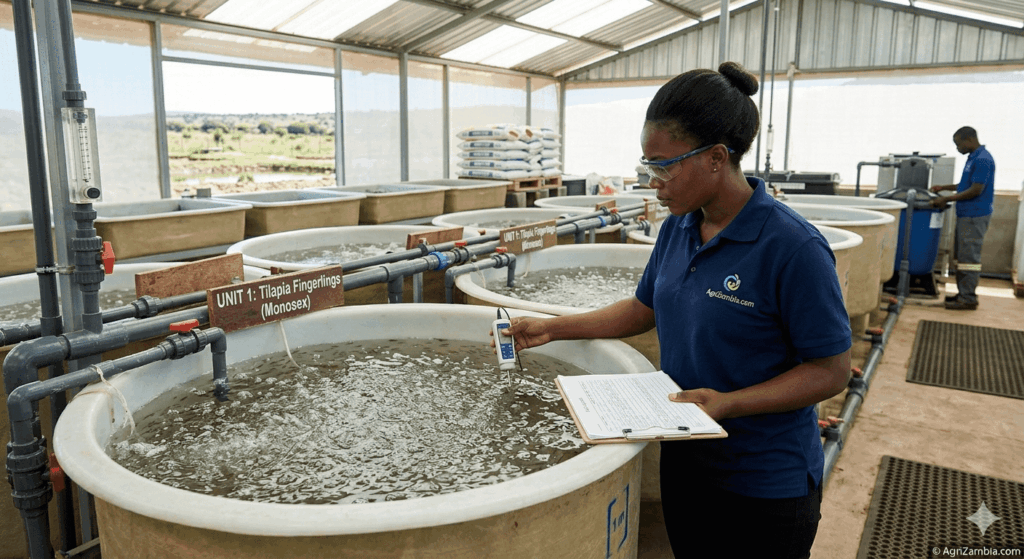
Capital expenses are your one-time investments to get the infrastructure up and running. For a standard startup venture utilizing three 450m² earthen ponds, expect the following structural costs:
Pond Construction & Earthworks
- Cost Range: ZMW 12,000 to ZMW 20,000
- Details: This involves hiring manual labor or a light excavator to clear topsoil, dig the basins, and build up secure, sloped dykes.
Water Reticulation & Sourcing
- Cost Range: ZMW 20,000 to ZMW 35,000
- Details: Relying on rain or seasonal streams is highly risky. This cost covers drilling a reliable borehole or securing a heavy-duty pump line from a permanent water source, alongside standard piping and a solar-assisted pumping array to minimize ongoing ZESCO electricity bills.
Basic Farm Tools & Equipment
- Cost Range: ZMW 4,000 to ZMW 7,000
- Details: Essential tools include a digital water testing kit (pH and Dissolved Oxygen meters), fine-mesh inlet/outlet screens to keep predators out, harvesting drag nets (seine nets), and a digital hanging scale to track fish growth.
2. Operational Expenditure (OPEX): Running Costs Per Cycle
Operational expenses are the recurring variables you must pay out during each 6-to-7-month growth cycle. Feed alone accounts for 60% to 70% of this budget.
Monosex Fingerlings
- Cost Range: ZMW 1.20 to ZMW 1.80 per fingerling
- Details: For three 450m² ponds stocked at a conservative semi-intensive rate (roughly 4 to 5 fish per square meter), you will need approximately 6,000 all-male monosex Tilapia fingerlings.
- Total Fingerling Cost: ZMW 7,200 to ZMW 10,800
Commercial Floating Feed
- Cost Range: ZMW 420 to ZMW 550 per 25kg bag (Depending on brand e.g., Tiger Feeds, Novatek, Aller Aqua, Namfeeds)
- Details: Fish require high-protein starter crumbles during their first few weeks, transitioning to grower pellets (2mm to 3mm), and finishing on 4mm pellets. To bring 6,000 fish to a market-ready weight of 400 grams, you will require roughly 2.5 metric tons of feed over a cycle.
- Total Feed Cost: ZMW 42,000 to ZMW 55,000
Pond Conditioning (Lime & Manure)
- Cost Range: ZMW 1,500 to ZMW 3,000
- Details: Before stocking, earthen ponds must be treated with agricultural lime to stabilize soil pH and organic manure (chicken or cattle dung) to boost natural algae production.
Labor and Security
- Cost Range: ZMW 12,000 to ZMW 16,000 (Over 7 months)
- Details: Covers the cost of daily farm hands responsible for disciplined timed feeding, water quality monitoring, weed control, and overnight security against theft.
3. Estimated Cost Summary Table (Smallholder Blueprint)
Below is a realistic financial summary for a standard three-pond (450m² each) production cycle targeting a harvest weight of 400g per fish:
| Expense Category | Minimum Budget (ZMW) | Maximum Budget (ZMW) |
| Pond Excavation & Infrastructure | ZMW 12,000 | ZMW 20,000 |
| Borehole & Solar Water Setup | ZMW 20,000 | ZMW 35,000 |
| Startup Equipment & Kits | ZMW 4,000 | ZMW 7,000 |
| Monosex Fingerlings (6,000 units) | ZMW 7,200 | ZMW 10,800 |
| Commercial Floating Feed (2.5 Tons) | ZMW 42,000 | ZMW 55,000 |
| Lime, Manure & Operational Labor | ZMW 13,500 | ZMW 19,000 |
| Total Estimated Initial Capital Required | ZMW 98,700 | ZMW 146,800 |
Note: In your subsequent farming cycles, your setup infrastructure costs drop to nearly zero, meaning your cash investment will only be tied to operational expenses like feed, fingerlings, and labor.
4. Balancing the Books: Market Value and Revenue Potential
To evaluate whether the cost is worth it, look at the potential market returns in Zambia:
- Expected Yield: Assuming a standard 10% mortality rate, 5,400 out of your 6,000 stocked fingerlings will survive to harvest. At an average weight of 400g (0.4kg) per fish, your total harvest yield equals 2,160kg of table-sized fish.
- Wholesale Market Pricing: Fresh local Tilapia fetches between ZMW 50.00 and ZMW 65.00 per kilogram at farm-gate wholesale prices, depending on proximity to major urban markets like Lusaka or the Copperbelt.
- Gross Projected Revenue: 2,160kg × ZMW 55.00 = ZMW 118,800
5. Top Cost-Saving Strategies for Zambian Farmers
If your starting capital is tight, avoid cutting corners on fingerling quality or starvation methods. Instead, optimize your expenses with these three proven tactics:
- Leverage Solar Water Systems: Electric grid connectivity can carry high tariff brackets and erratic loads. Investing in a solar-powered borehole pump drastically reduces your long-term monthly utility fees.
- Utilize Organic Fertilization: Properly liming and manuring your earthen ponds breeds heavy blooms of natural green algae and plankton. This natural food source allows you to slightly reduce your feed dependency during the initial grower phase without compromising health.
- Time Your Cycle Wisely: Avoid heavy stocking right before the coldest winter months (May to July). Tilapia metabolism slows down drastically when water temperatures drop below 20°C, meaning they will eat less and grow slower, causing you to burn through operational capital with zero weight gain. Stock your fish so their primary grow-out phase falls during the warm, high-growth months.
Conclusion
Understanding the true cost of fish farming in Zambia is the absolute foundation of building a profitable, long-term aquaculture business. While the upfront capital required for high-quality earthworks and solar water pumping systems can seem demanding, these one-time investments dramatically lower your overheads and de-risk your operations for every subsequent harvest cycle.
When you treat your farm with strict operational discipline—prioritizing premium commercial feed, managing water quality relentlessly, and avoiding high-risk seasonal temperature dips—the numbers clearly show that the local market yields excellent financial returns.
Ready to transition from basic budgeting to full-scale implementation? To dive deeper into the technical mechanics of building your ponds, selecting your stock, and mastering daily farm operations, read our comprehensive, step-by-step guide on Commercial Fish Farming in Zambia.