
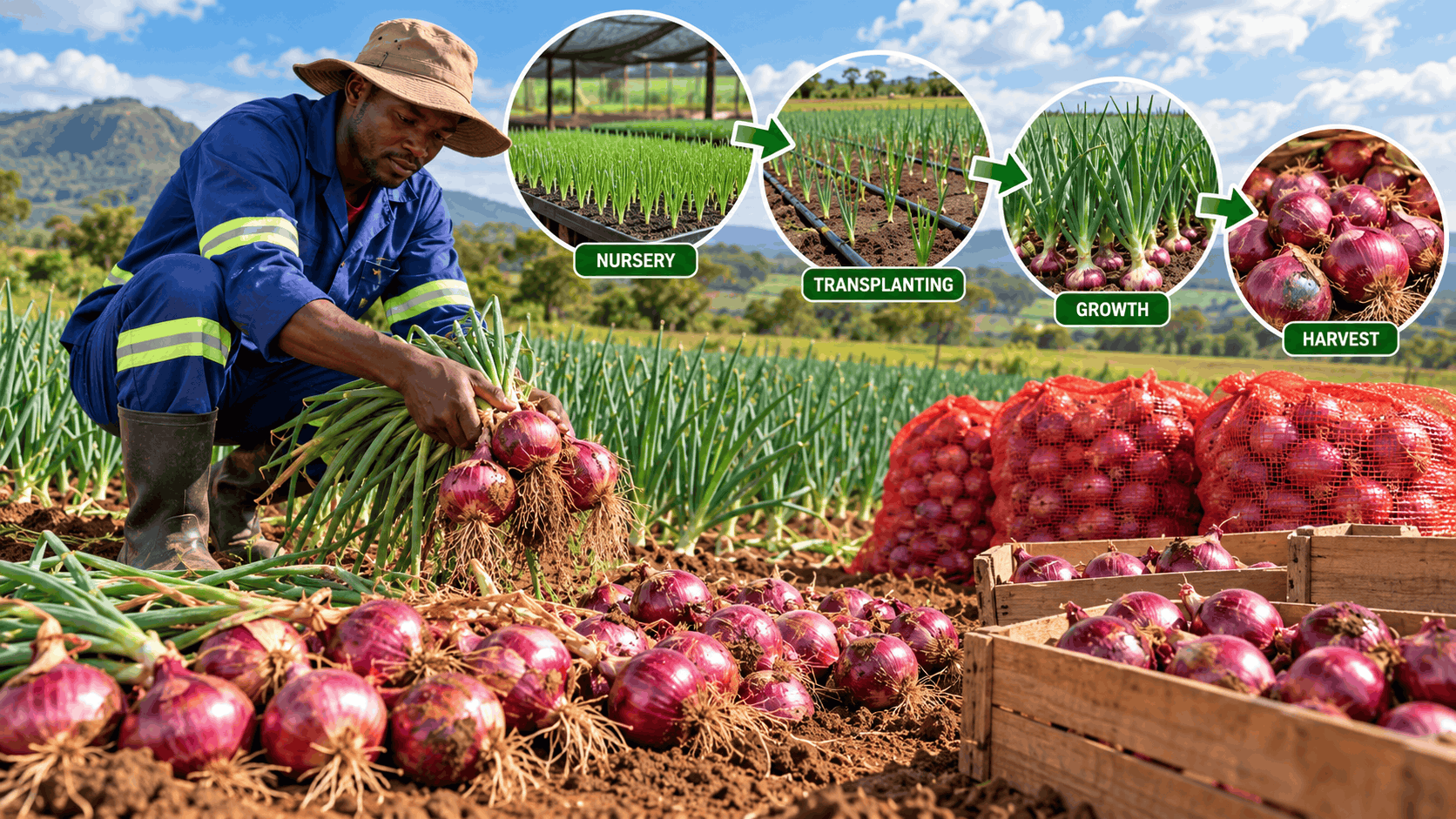
Onion farming stands out as one of the most profitable commercial horticultural enterprises in Zambia. Because onions are a daily staple consumed across virtually every household, restaurant, and market in the country, demand remains consistently high throughout the year. For commercial growers who master planting schedules, soil nutrition, pest management, and post-harvest curing, onions offer exceptional returns per hectare.
This comprehensive guide covers everything you need to know about commercial onion production in Zambia, walking you through every critical phase from initial field setup to final market sales.
1. Getting Started with Onion Farming in Zambia
Starting a successful onion farm requires clear business planning, adequate working capital, and a solid understanding of local climatic conditions. Unlike hardier root crops, onions have a shallow, delicate root system and are sensitive to temperature and daylight hours.
To start, you need suitable land with access to a reliable water source, as onions require consistent moisture throughout their four- to five-month growth cycle. Capital is required upfront for land preparation, seed purchase, fertilizers, crop protection chemicals, labor, and irrigation infrastructure.
Beginning small—such as with a quarter-hectare or half-hectare plot—allows you to master the delicate nursery stage and crop management before scaling up to multi-hectare operations.
2. Choosing the Best Onion Varieties for Zambia
Zambia’s geographical location requires “short-day” or “intermediate-day” onion varieties. Short-day varieties require about 11 to 12 hours of daylight to trigger bulb formation, making them ideal for the Southern African region.
Popular and proven commercial varieties grown in Zambia include:
- Red Creole: A popular open-pollinated variety known for its deep red color, pungent flavor, excellent storage capability, and strong resistance to disease.
- Texas Early Grano: A high-yielding yellow onion with a sweet, mild flavor. It forms large, globe-shaped bulbs quickly but has a shorter shelf life than Red Creole.
- Bombay Red: Very popular in regional local markets due to its dark red skin, strong aroma, and good tolerance to warm temperatures.
- Commercial Hybrids (e.g., Elad, Neptune, Sagittarius): Hybrid varieties offer uniform bulb size, high disease resistance, and significantly higher yields per hectare, though their seeds are more expensive upfront.
Select a variety based on your target market: red, pungent onions are preferred by open-air market vendors and local consumers due to their long storage life, while large yellow hybrids are favored by hotels and commercial buyers.
Check out our detailed article Best Onion Varieties to Grow in Zambia for more information.
3. The Best Time to Plant Onions in Zambia
Timing is the single most critical factor in Zambian onion farming. The ideal window for sowing onion seeds in the nursery is between late February and April.
- Late February to March (Nursery Sowing): Sowing during this period allows seedlings to grow in the nursery while the heavy rainy season winds down.
- April to May (Transplanting): Transplanting out into the main field occurs as cool, dry winter weather sets in.
- August to October (Harvesting): The crop develops bulbs during the cool winter and matures as warm, dry spring weather arrives. Harvesting in hot, dry weather ensures ideal conditions for curing and drying bulbs without risk of rot from rain.
Planting too early (during heavy rains in December or January) leads to severe fungal outbreaks and nursery damping-off. Planting too late (June or July) means the bulbs mature during the rainy season, making harvesting and drying extremely difficult.
4. Land Preparation and Soil Requirements
Onions grow best in deep, well-drained, friable sandy-loam or loamy soils rich in organic matter. They are extremely sensitive to waterlogging and soil compaction. The optimal soil pH range is between 6.0 and 6.8; acidic soils with a pH below 5.5 restrict root growth and reduce nutrient uptake, leading to stunted plants.
Land preparation should begin several weeks before transplanting:
- Ploughing: Plough the land deeply (25 to 30 cm) to break up hardpans and allow easy root expansion.
- Harrowing: Disc or harrow the field thoroughly to create a fine, clod-free soil tilth. Onions cannot establish well in cloddy, rough soil.
- Bed Construction: Construct raised beds (15 to 20 cm high and 1 meter wide). Raised beds improve drainage, prevent waterlogging around roots, and make weeding and harvesting significantly easier.
5. Raising Onion Seedlings in the Nursery
Direct seeding in the field is rarely done in Zambia due to high weed competition and poor seed survival. Raising seedlings in a controlled nursery bed ensures high survival rates and uniform growth.
Nursery Setup
Choose a nursery site with rich soil, full sunlight, and easy access to clean water. Construct seedbeds 1 meter wide and of any convenient length. Incorporate well-rotted animal manure or a light basal fertilizer into the topsoil.
Sowing
Make shallow furrows 10 to 15 cm apart across the bed, about 1 cm deep. Sow the seeds thinly along the rows to avoid overcrowding, which leads to weak, spindly seedlings. Cover lightly with fine soil and a thin layer of grass mulch to retain moisture. Seed requirements generally range from 3.5 to 5 kilograms per hectare.
Care and Maintenance
Water the nursery beds gently twice daily using a fine rose watering can. Remove the grass mulch as soon as seeds sprout (usually within 7 to 10 days). Keep the beds meticulously weed-free and protect young seedlings from fungal damping-off using light copper-based fungicide applications if necessary. Seedlings are ready for transplanting in 6 to 8 weeks, when they reach the thickness of a standard pencil (about 5 to 7 mm in diameter).
6. Transplanting, Spacing, and Plant Population
Transplanting should be done late in the afternoon or on an overcast day to minimize transplant shock caused by high temperatures.
- Seedling Preparation: Water the nursery bed thoroughly a few hours before pulling seedlings to avoid snapping roots. Trim long leaves slightly to reduce water loss through transpiration.
- Spacing: Plant in rows spaced 15 to 20 cm apart on the raised beds, with plants spaced 8 to 10 cm apart within each row.
- Plant Population: Proper spacing yields an optimal plant density of roughly 600,000 to 800,000 plants per hectare. Higher densities yield smaller, uniform bulbs suitable for general retail, while wider spacing yields large individual bulbs favored by specialty markets.
- Planting Depth: Insert seedlings shallowly into the moist soil—no deeper than 2 to 3 cm. Planting too deep prevents the bulb from expanding freely, leading to elongated, misshapen onions.
7. Fertilizer Requirements and Crop Nutrition
Onions are heavy feeders with a shallow root system, meaning nutrients must be readily available in the top 20 cm of soil.
Basal Application
Apply a compound basal fertilizer high in phosphorus and potassium—such as Compound C (6:18:12) or Compound S—during land preparation or just before transplanting. Apply approximately 800 to 1,000 kg per hectare, thoroughly mixing it into the raised beds to support early root setup.
Top-Dressing
Onions require targeted nitrogen applications during their early leafy growth stage to build a strong canopy before bulb formation begins (each healthy leaf above ground corresponds to an inner scale ring in the bulb).
- First Top-Dressing: Apply Ammonium Nitrate (AN) or Calcium Ammonium Nitrate (CAN) at 150 to 200 kg per hectare roughly 3 weeks after transplanting.
- Second Top-Dressing: Apply a second round of nitrogen combined with potassium (such as Potassium Nitrate or AN) around 6 to 7 weeks after transplanting.
Critical Rule: Stop all nitrogen fertilization once bulb formation begins (around 9 to 10 weeks after transplanting). Late nitrogen applications cause thick, soft necks, split bulbs, poor drying, and severe rot during storage.
8. Irrigation and Water Management
Because onion roots rarely penetrate deeper than 30 cm, the crop requires steady, reliable water. Fluctuations between overly wet and bone-dry soil cause stress, leading to split bulbs, double bulbs, and reduced overall size.
Irrigation Frequency
During early establishment and warm weather, onions require water every 2 to 3 days, delivering roughly 25 to 35 mm of water per week. As winter sets in, irrigation can be reduced to once every 4 to 5 days, depending on soil type.
Irrigation Methods
- Drip Irrigation: The most efficient method for onion farming in Zambia. Drip systems deliver water directly to the root zone, save up to 50% more water than overhead sprinklers, reduce weed growth between rows, and keep leaves dry to minimize fungal diseases.
- Overhead Sprinklers / Hose Systems: Common on smaller farms, but high leaf moisture increases the incidence of leaf blights and fungal infections.
Water Withdrawal: Stop watering completely when 50% to 70% of the plant tops naturally fall over (lodge). Withholding water at this stage encourages the plant to draw remaining nutrients from the leaves into the bulb and allows the necks to dry out properly.
9. Pest and Disease Management
Humid weather, poor weed management, and continuous cropping create ideal environments for onion pests and pathogens.
Common Pests
- Thrips (Onion Thrips): Tiny, slender insects that scrape the surface of onion leaves to feed on sap. They cause silvery streaks or blotches on leaves, reducing photosynthesis and severely stunting bulb growth. Control thrips using systemic or contact insecticides (such as imidacloprid, lambda-cyhalothrin, or profenofos) at the first sign of damage.
- Cutworms: Caterpillars that hide in the soil during the day and sever young transplants at ground level during the night. Apply suitable soil insecticides or bait around transplants early in the cycle.
Common Diseases
- Purple Blotch: A fungal disease causing water-soaked spots on leaves that turn purple with yellow halos. Leaves eventually die, drastically cutting yield. Prevent with crop rotation and spray preventive copper-based or mancozeb fungicides.
- Downy Mildew: Appears as pale green or yellowish spots on leaves covered with a violet-grey mold during cool, wet mornings. Prevent with fungicides containing metalaxyl or chlorothalonil.
- Damping-Off: A common soil-borne fungal issue in nursery beds causing seedling stems to rot at ground level. Prevent by avoiding overwatering and using treated seeds in clean beds.
10. Troubleshooting Low Yields and Poor Bulb Formation
Farmers occasionally experience poor harvests where plants fail to form round bulbs or yield small, thick-necked onions. The primary reasons include:
- Wrong Variety Selection: Growing long-day onion varieties in Zambia will result in healthy green leaves but zero bulb formation, as local daylight hours are too short to trigger bulbing.
- Excessive Late Nitrogen: Feeding nitrogen during the bulbing phase forces the plant to continue producing leaves instead of transferring energy into the bulb, creating thick “bull-necks” that rot easily.
- Water Stress During Bulbing: Irregular watering when bulbs are expanding causes irregular shapes, split bulbs, and premature stoppage of growth.
- Weed Competition: Onions have thin, upright leaves that offer no shade to suppress weeds. Heavy weed growth rapidly starves onions of light, water, and fertilizer.
11. Yield Expectations and Cost Breakdown
Yield Potential
Under good commercial management using certified seeds, proper fertilization, and drip irrigation, onion yields in Zambia range from 30 to 50 tonnes per hectare (30,000 to 50,000 kg). Elite hybrid varieties under exceptional management can exceed 60 tonnes per hectare.
Cost Considerations
Cost structures vary depending on farm scale, irrigation setup, and labor costs, but key expense drivers for one hectare typically include:
- Certified Seed / Hybrids: Significant upfront cost for high-yielding varieties.
- Fertilizers: Basal Compound C/S plus nitrogen top-dressings make up a major portion of input budgets.
- Irrigation Setup: Fuel/electricity for water pumping and drip tape installation.
- Labor: Nursery preparation, manual transplanting, weeding, harvesting, and sorting require substantial seasonal labor.
- Packaging: Mesh bags (typically 10 kg kg capacity) for wholesale marketing.
Despite the initial investment, high yields combined with favorable off-season market prices make onions one of the highest returning horticultural crops per acre in the region.
12. Harvesting, Curing, and Storage
Proper post-harvest handling determines whether your onions sell at a premium or rot before reaching the market.
Harvesting
Harvesting should begin when 50% to 70% of the crop’s leafy tops have fallen over naturally. Do not wait for all tops to dry out completely in the soil, as late harvesting exposes mature bulbs to soil pests and sun scalding. Gently loosen the soil around the bulbs and pull plants up by hand.
Curing
Curing is the process of drying the outer bulb scales and neck tissues to seal the onion against bacteria and moisture loss.
- Field Windrowing: Lay harvested onions in the field in rows so the leaves of one plant cover the bulbs of another, protecting them from direct scorching sun. Allow them to dry for 3 to 7 days until necks become limp and papery.
- Shed Curing: Alternatively, transfer onions to a well-ventilated structure or shaded open-sided shed, spreading them out on slatted racks or dry ground for 2 to 3 weeks until the necks are completely dry and sealed.
Trim dried tops leaving about 2.5 to 3 cm of dry neck attached to the bulb. Never trim wet, green necks immediately after harvesting, as this creates an open wound for rot fungi to enter.
Storage
Store cured onions in a cool, dry, dark, and well-ventilated facility. Pack onions into breathable mesh bags and stack them on wooden pallets—never directly on bare concrete floors. Do not store onions near potatoes or fruits that release ethylene gas, as this triggers early sprouting. Well-cured Red Creole or hybrid onions can store successfully for 3 to 6 months under proper conditions.
13. Grading, Packaging, and Marketing Strategies
To command the highest market prices, grade your onions before taking them to point of sale:
- Large / Extra Large: Uniform bulbs above 70 mm in diameter, ideal for commercial kitchens, hotels, and high-end supermarkets.
- Medium: Bulbs between 50 mm and 70 mm, the most popular size for general household sales.
- Small / Picklers: Bulbs under 50 mm, sold at lower prices in open markets or to food processors.
Pack graded onions in clean 10 kg ventilated mesh bags for standard wholesale distribution.
Market Timing Strategy
Market prices for onions in Zambia follow strong seasonal cycles:
- Low Price Window (August to November): Supply peaks as many farmers harvest rain-free winter crops simultaneously, driving prices down in major wholesale hubs like Soweto Market in Lusaka or urban centers in the Copperbelt.
- High Price Window (January to April): National supply drops significantly during the heavy rainy season because curing and storage are difficult. Farmers who successfully store their dry winter harvest or cultivate early off-season crops under protected conditions can sell at peak market prices, securing double or triple the returns compared to peak harvest season.
Check about the Profitability of Onion Farming in Zambia
Final Thoughts for Success
Commercial onion farming in Zambia offers massive financial potential, but it is not a low-effort crop. Success requires precision at every step—from calculating exact planting dates and choosing adapted varieties to enforcing strict curing standards after harvest. By adhering to sound agronomic practices and timing your harvest for high-demand market windows, your onion enterprise can grow into a highly profitable, sustainable business.