
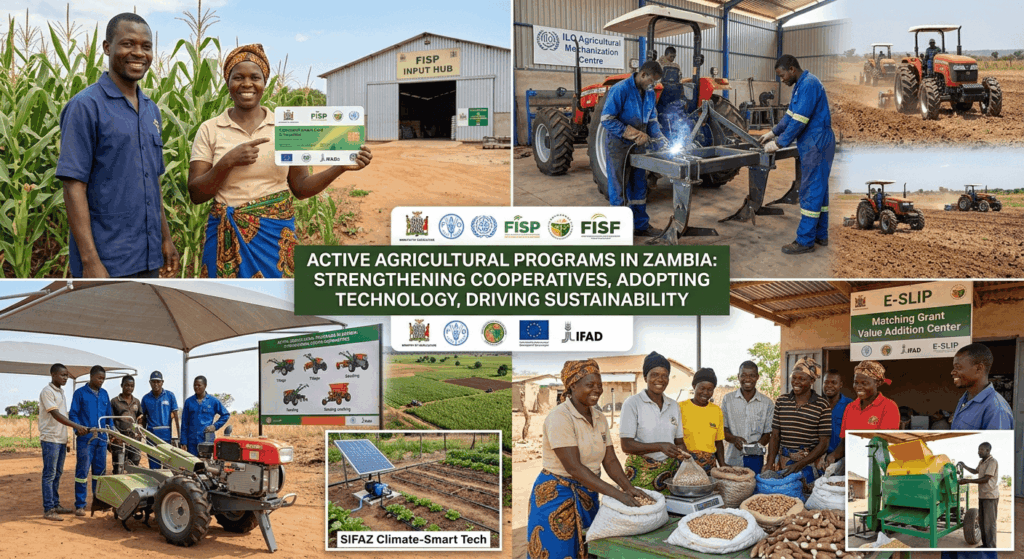
Agriculture is the strategic engine driving Zambia’s rural economy, providing employment, food security, and a pathway to industrialization. Facing increasingly unpredictable weather patterns and hard economic realities, the Ministry of Agriculture, alongside multilateral partners and financial institutions, has rolled out a suite of dynamic frameworks designed to support everyone from smallholder cooperatives to heavy commercial estates.
If you are a farmer, agribusiness investor, or development stakeholder in Zambia, keeping up with these initiatives is essential. Here is a definitive breakdown of the major active agricultural programs shaping farming blocks across the country.
1. The Comprehensive Agricultural Support Programme (CASP)
The Comprehensive Agricultural Support Programme (CASP) represents the landmark modernization and restructuring of Zambia’s agricultural input framework. Serving as the successor to the legacy Farmer Input Support Programme (FISP), CASP moves away from simple input distribution to drive holistic value-chain development, infrastructure support, and climate resilience.
True Crop Diversification: While the old FISP models historically over-subsidized maize, CASP leverages the flexibility of the digital e-voucher to give smallholders a wide array of choices. Beneficiaries can strategically purchase cash crop seed lines (like soy, groundnuts, and cotton), livestock treatments, and specialized fertilizers tailored to their specific soil demands.
The Complete E-Voucher Migration: A core pillar under CASP is the definitive transition to a 100% electronic voucher (e-voucher) platform across all 116 districts, completely phasing out the logistically heavy Direct Input Supply (DIS) system. Farmers make their localized contribution via digital channels or mobile money, which is instantly topped up by the government to allow rapid redemption at registered private agro-dealers.
2. Sustainable Agriculture Financing Facility (SAFF)
Recognizing that limited access to capital stifles agricultural expansion, the government established the Sustainable Agriculture Financing Facility (SAFF).
- Target Audience: SAFF is structured explicitly as an affordable, performance-driven financing avenue for emerging and medium-scale commercial farmers who do not qualify for basic social protection but are priced out by standard commercial bank interest rates.
- The Focus: The credit facility provides flexible financing loops paired with vetted agro-dealers. It allows emerging agribusinesses to securely acquire advanced inputs, precision seed lines, solar irrigation equipment, and post-harvest machinery.
3. Climate-Smart Agriculture Initiatives: EP-JSLP & SIFAZ
With climate change threatening rain-fed agriculture, large-scale sustainable framework interventions have scaled up nationwide.
Eastern Province Jurisdictional Sustainable Landscape Programme (EP-JSLP)
Building upon the foundations of the Zambia Integrated Forest Landscape Project (ZIFLP), the EP-JSLP stands as a landmark emissions-reduction initiative.
- How it works: It trains smallholders across Eastern Province in conservation agriculture, agroforestry (such as planting nitrogen-fixing Gliricidia trees), and sustainable land management.
- The Long-Term Benefit: Beyond dramatically improving soil health and crop resilience, the program structures communities to capture future revenues via global carbon credit frameworks.
Sustainable Intensification of Smallholder Farming Systems (SIFAZ)
Implemented by the Food and Agriculture Organization (FAO), CIMMYT, and the Ministry of Agriculture under European Union funding, SIFAZ focuses directly on structural technology approval. The program has validated and deployed highly specific, climate-resilient farming systems:
- Cassava Intercropping under Conservation Agriculture: Optimizes land use while protecting topsoil.
- Double Cropping of Beans & Doubled-Up Legumes: Dramatically boosts soil fertility naturally while diversifying household nutrition and income.
- Integrated Fodder Production: Merges crop cultivation with ready livestock feed management to alleviate dry-season forage shortages.
4. Enhanced Smallholder Livestock Investment Programme (E-SLIP)
Managed by the Ministry of Fisheries and Livestock with backing from the International Fund for Agricultural Development (IFAD), E-SLIP handles the structural commercialization of the livestock value chain.
- The Matching Grant Facility (MGF): A standout pillar of E-SLIP is its co-financed grant windows.
- Funding Windows: Grants range from small allocations (K25,000 to K150,000) for smallholders to install secure animal housing or forage irrigation, up to large strategic grants (up to K500,000+) for agribusinesses and cooperatives constructing cold-chain storage and milk-chilling centers.
5. National Agricultural Mechanization Strategy
Zambia’s smallholders have historically suffered from a production ceiling imposed by manual hand-hoeing. The National Agricultural Mechanization Strategy aims to break this reliance on manual labor.
- Mechanization Service Centres: Backed by international development banks, the initiative builds regional hubs that house high-tech machinery.
- Leasing Modality: Rather than requiring farmers to buy expensive machinery outright, these centers lease out utility tractors, specialized rippers, and precision multi-row planters directly to smallholder cooperatives at subsidized rates.
Conclusion: How Farmers Can Benefit
Zambia’s agricultural landscape is rapidly shifting away from chaotic, rain-dependent farming toward structured, predictable, and climate-resilient agribusiness models. These programs present massive opportunities, but they require farmers to be proactive.
To leverage these frameworks, ensure your agribusiness is formally registered, join a local district farmer cooperative, and maintain active contact with your local Agricultural Camp Extension Officer. Taking advantage of e-voucher flexibility, climate-smart technologies, and matching grants will allow you to protect your land, maximize your seasonal yields, and run a highly profitable operation.