
The Ultimate Guide to Aquaculture: Commercial Fish Farming in Zambia
Aquaculture (Fish Farming) is one of the fastest-growing agribusiness sectors in Zambia. With over 40% of the water resources in the Southern African Development Community (SADC) region located within its borders, Zambia possesses immense natural potential for fish production. However, a significant deficit between local demand and domestic supply persists, forcing the country to rely heavily on imports.
For the modern Zambian agropreneur, this supply gap represents a massive commercial opportunity. This comprehensive, SEO-optimized pillar guide breaks down the technical, economic, and practical steps required to build, stock, manage, and scale a highly profitable fish farming business in Zambia.
1. The Market Opportunity: Why Invest in Zambian Aquaculture?
Zambia’s national fish consumption stands at over 140,000 metric tons per year, yet domestic production historically hovers significantly below this demand. The deficit is currently met through frozen fish imports from countries like Namibia and China.
Investing in local aquaculture offers several distinct strategic advantages:
- High Market Demand: Fish is a preferred, affordable source of animal protein across both rural and urban populations along the line of rail (from Livingstone to the Copperbelt).
- Favorable Environment: Vast aquatic networks including the Zambezi, Kafue, Luapula, and Chambeshi river basins, alongside lakes like Kariba, Tanganyika, and Bangweulu, provide excellent hydrological foundations.
- Government Support: The Ministry of Fisheries and Livestock, alongside development finance initiatives like the Zambia Aquaculture Enterprise Development Project (ZAEDP), actively supports smallholders and commercial outfits with technical training and credit lines.

2. Choosing Your Fish Species: Tilapia vs. Catfish
To run a successful fish farm, you must cultivate species that thrive in local climatic zones and enjoy strong consumer preference. In Zambia, two primary groups dominate the market:
Three-Spotted Tilapia (Oreochromis andersonii) and Nile Tilapia (Oreochromis niloticus)
Tilapia is the undisputed king of the Zambian fish market, locally referred to as Breama.
- Pros: Highly adapted to local warm temperatures, accepts formulated artificial diets readily, boasts excellent meat quality, and commands premium market prices.
- Growth Cycle: Reaches a marketable weight of 350g to 500g within 6 to 8 months under optimal management.
- Note on Regulations: While Nile Tilapia (O. niloticus) grows faster, its farming is heavily restricted or regulated in certain natural basins (such as parts of the Kafue system) by the Department of Fisheries to protect indigenous biodiversity. Oreochromis andersonii is widely encouraged for commercial farming nationwide.
African Catfish (Clarias gariepinus)
Locally known as Mulonge, catfish is highly resilient but occupies a distinct market niche.
- Pros: Extremely hardy, tolerates low water quality and low dissolved oxygen levels, can be stocked at much higher densities than tilapia, and grows faster to larger sizes.
- Growth Cycle: Can reach 1kg or more within 6 to 7 months.
- Market Tip: While highly profitable, catfish commands lower fresh-market demand than tilapia in certain urban areas. It is highly sought after in dried, smoked, or specialized commercial processing formats.
3. Selecting the Right Production System
Your chosen system dictates your initial capital expenditure (CAPEX), running operational costs (OPEX), and daily management routines.
A. Earthen Ponds
The most common and sustainable system for small-to-medium enterprises (SMEs) across Zambia’s agricultural blocks (e.g., Mkushi, Chibombo, Chongwe).
- Requirements: Soil must have a high clay content (at least 30–40%) to retain water efficiently without excessive seepage.
- Pros: Low operational cost, utilizes natural productivity (algae and plankton) when properly fertilized, and offers excellent thermal stability for the fish.
- Cons: Requires substantial land space and significant water volumes to counter evaporation.
B. Concrete and Liner Tanks
Ideal for urban and peri-urban setups (such as small plots in Lusaka or Kitwe) where land is limited or soil is sandy.
- Requirements: Constant water supply and power for water exchange or aeration.
- Pros: Complete control over predators, easier harvesting, and very high stocking densities per square meter.
- Cons: High initial construction cost; fish rely 100% on high-quality commercial feed as no natural food grows in clean tanks.
C. Floating Cages
Utilized by large-scale commercial entities on vast open water bodies like Lake Kariba or Lake Bangweulu.
- Requirements: Concessions and environmental permits from the Zambia Environmental Management Agency (ZEMA) and the Department of Fisheries.
- Pros: Incredible water exchange rates, optimal dissolved oxygen, and massive production capacities.
- Cons: Vulnerable to environmental shifts, water pollution, theft, and high initial investment costs for cages and security.
4. Site Selection and Water Quality Management
The failure of many aquaculture startups in Zambia stems directly from poor site selection or a lack of understanding of water parameters.
Soil and Topography
If building earthen ponds, avoid rocky or purely sandy terrains. The topography should ideally be gently sloping to allow for cost-effective, gravity-fed filling and draining systems, eliminating the need for expensive, continuously running fuel or electrical pumps.
Water Source and Security
Your water source must be reliable year-round. Relying purely on seasonal streams or shallow wells will result in disaster during the hot dry season (September to November).
- Boreholes: The safest, cleanest source of water, free from wild pathogens and agricultural chemical runoff.
- Rivers/Streams: Highly cost-effective but must be monitored for upstream pollution, pesticides from commercial crop farms, and wild fish entry.
Optimal Water Parameters for Tilapia
| Parameter | Ideal Range | Impact on Fish Health |
| Temperature | 25°C to 30°C | Growth slows drastically below 20°C; feeding stops below 15°C. |
| pH Level | 6.5 to 8.5 | Acidic water (below 6.0) stresses fish and damages gill function. |
| Dissolved Oxygen (DO) | 5.0 mg/L to 7.0 mg/L | Low oxygen causes gasping at the surface, poor feed conversion, or mass mortality. |
| Ammonia | < 0.05 mg/L | High ammonia from decomposing feed and fish waste is highly toxic. |
5. Pond Construction: Step-by-Step Engineering
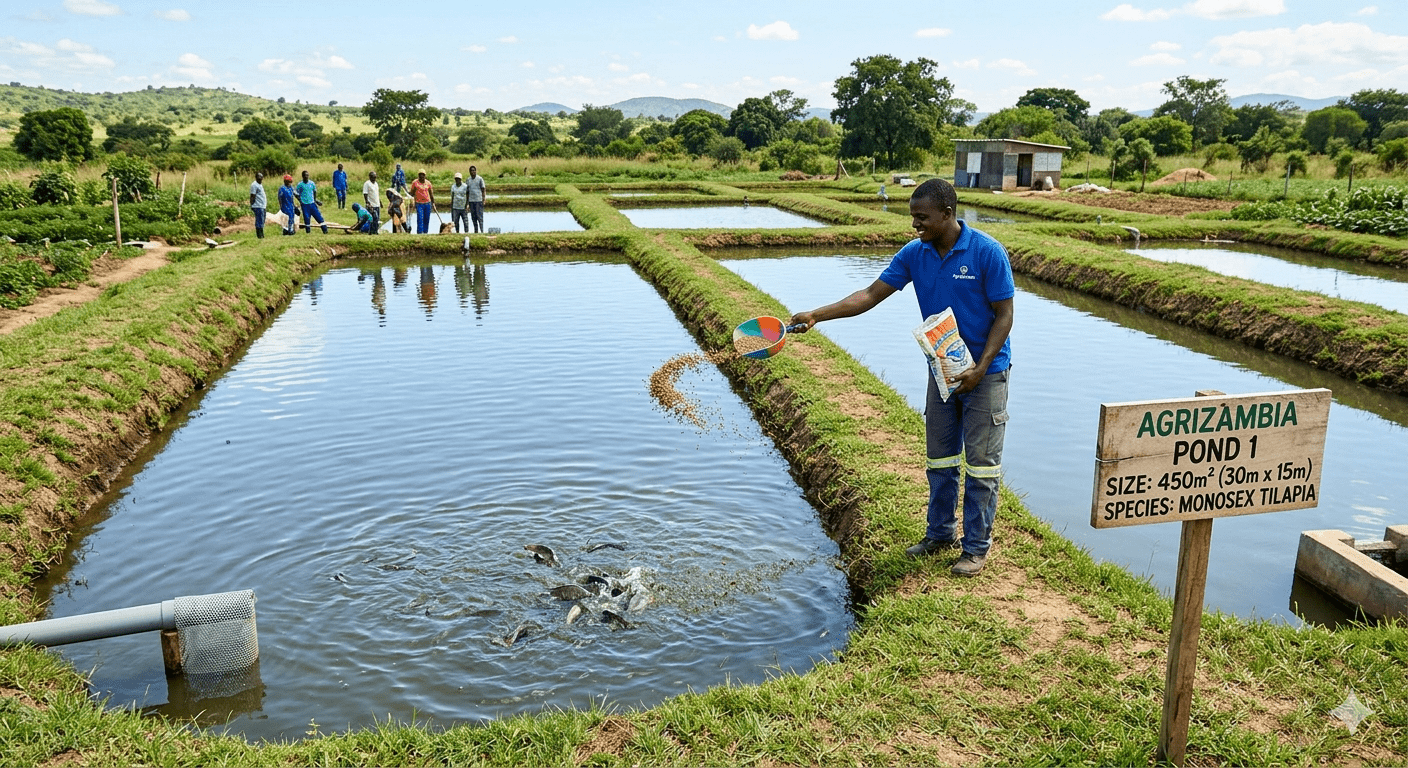
When constructing an earthen pond, stick to standard commercial dimensions to make management and harvesting efficient. A standard starter size is a 20m × 10m (200m²) or 30m × 15m (450m²) pond
       Inlet (Water Source)
        │
  ┌─────▼───────────────────────────┐  ◄─── Shallow End (1.0m Depth)
  │                                 │
  │     Pond Bottom Slopes Down     │
  │                                 │
  └───────────────────────────┬─────┘  ◄─── Deep End (1.5m Depth)
                              │
                              ▼
                         Outlet / Monk System (Drainage)
- Clearing and Grubbing: Remove all trees, roots, and topsoil from the designated footprint. Topsoil contains organic matter that leaks gas when submerged.
- Excavation: Dig out the core area, placing the soil on the edges to build strong dykes (walls). Ensure the slopes of the dykes have a 2:1 or 3:1 ratio to prevent collapsing.
- Sloping the Floor: The bottom must slope gently from a shallow end (1.0 meter depth) to a deep end (1.5 meters depth). This gradient ensures the pond drains completely during harvest.
- Installing Inlets and Outlets: Keep the water inlet at the shallow end and the outlet at the bottom of the deep end. Use fine mesh screens over both pipes to prevent wild fish from entering and your stocked fingerlings from escaping.
6. Sourcing Quality Fingerlings and Stocking Density
The Importance of Monosex Fingerlings
Always purchase all-male (monosex) Tilapia fingerlings from certified, reputable hatcheries in Zambia. Mixed-sex stocking leads to early, uncontrolled breeding inside your ponds. The fish will expend their energy reproducing rather than growing, leaving you with thousands of tiny, unmarketable, stunted fish.
Stocking Density Guidelines
- Earthen Ponds (Extensive/Semi-Intensive): Stock between 3 to 5 fish per square meter. In a 200m² pond, you should stock 600 to 1,000 fingerlings.
- Tanks/Cages (Intensive): Can range from 20 to 50+ fish per cubic meter, provided you have aggressive mechanical aeration, continuous clean water flushes, and highly stable power backups.
7. Feed Management and Nutrition
Feeding accounts for 60% to 70% of the total variable costs in a Zambian aquaculture business. Skimping on feed quality or using poor feeding techniques will destroy your profit margins.
Commercial Feed vs. On-Farm Formulations
For commercial success, utilize floating pelleted feeds available from prominent local millers (such as Tiger Feeds, Novatek, Aller Aqua, or Skretting).
- Starter Feeds (Powder/Micro-pellets): High protein content (40–45%) required for fingerlings and juveniles.
- Grower Feeds (2mm to 4mm pellets): 30–35% protein content to build muscle mass rapidly during months 3 to 6.
- Finisher Feeds: 26–30% protein to maintain weight just before harvest.
Feeding Strategies
- The Response Method: Feed your fish twice or thrice daily at designated times (e.g., 09:00 hours and 15:00 hours when water temperatures are optimal). Only throw feed that the fish can consume within 15 minutes.
- Avoid Overfeeding: Excess feed sinks to the bottom, decomposes, consumes dissolved oxygen, and generates lethal ammonia gas.
8. Financial Projections and Profitability Analysis
Let’s look at a realistic, conservative estimate for a medium-scale smallholder running three 450m² earthen ponds over one 7-month production cycle.
Estimated Capital Expenditure (CAPEX)
- Pond Excavation & Civil Works (3 ponds): ZMW 15,000
- Water Reticulation (Borehole connection, piping, solar pump assist): ZMW 25,000
- Equipment (Nets, water testing kits, scale): ZMW 5,000
- Total CAPEX: ZMW 45,000
Estimated Operational Expenditure (OPEX per Cycle)
- Monosex Fingerlings (6,000 units @ ZMW 1.50 each): ZMW 9,000
- High-Quality Commercial Feed (approx. 2.5 Tons): ZMW 45,000
- Organic Manure/Lime for pond preparation: ZMW 2,000
- Labor & Security (7 months): ZMW 14,000
- Contingencies: ZMW 5,000
- Total OPEX: ZMW 75,000
Projected Revenue
- Assuming a conservative 10% mortality rate, 5,400 fish survive to harvest.
- Target average harvest weight: 400 grams per fish.
- Total harvest yield: 5,400 × 0.4kg = 2,160kg of fish
- Average local wholesale price per kg of fresh tilapia: ZMW 55.00.
- Gross Revenue: 2,160kg × ZMW 55 = ZMW 118,800
Net Profit Margin (First Cycle)
- Gross Revenue (ZMW 118,800) – OPEX (ZMW 75,000) = ZMW 43,800 Net Profit.
- Note: From the second cycle onward, your CAPEX drops to near-zero, significantly increasing your net returns.
9. Biosecurity, Health, and Risk Mitigation
While fish are generally resilient, poor management can introduce catastrophic risks.
Major Risks and How to Prevent Them
- The Winter Growth Halt: Between May and July, temperatures drop significantly across Zambia. Tilapia will slow down or stop feeding entirely. Do not waste money throwing heavy feed during cold spells. Reduce feeding frequencies and wait for August when temperatures rise.
- Predators: Birds (cormorants and kingfishers), frogs, and snakes can decimate your fingerling population. Install bird netting or overhead scare lines across the top of your ponds, and keep grass cut low around dykes to deter snakes.
- Algal Blooms: Intense sun combined with high nutrients from feed waste can cause massive algae growth. If your pond turns a very dark, pea-soup green, it is dangerous. At night, heavy algae consume oxygen rather than producing it, leading to early morning fish kills. Flush the pond with fresh water immediately.
10. Harvesting and Marketing Your Yield
Do not wait until harvest day to look for buyers. Start mapping your supply chain by month 4 of your growth cycle.
Marketing Strategies for Zambian Fish Farmers
- Local Community Sales: Selling directly from the farm gate to community members is highly profitable as it completely avoids transport overheads.
- Market Traders (Ba Market): Establish relationships with fish traders at local markets (e.g., Soweto Market in Lusaka, Chisokone in Kitwe). They buy in large bulk quantities, though at a slightly lower wholesale price.
- Restaurants and Lodges: High-end hospitality outlets require consistent, weekly supplies of uniform sizes (e.g., exact 400g portions). These contracts offer the highest profit stability.
- Value Addition: If you face transport bottlenecks, consider scaling your infrastructure to include smoking kilns or deep-freezing capacities to extend your product’s shelf life.
Conclusion
The massive supply gap in Zambia’s local fish market represents one of the most stable and high-yielding opportunities in modern agribusiness today. By moving away from traditional, unmanaged mixed-sex setups and adopting a disciplined commercial approach—using high-quality monosex fingerlings, strict feeding schedules, and standard-sized ponds like 200m² or 450m²—smallholders and commercial growers alike can achieve highly predictable returns.
While aquaculture demands careful attention to water quality management and significant upfront planning for operational costs, the long-term payoff is undeniable. As climate variability impacts traditional crop farming across Zambia, diversifying into resilient, structured fish production is not just a path to individual profitability, but a critical step toward national food security.
Map out your water source, secure your fingerling supply chain early, and treat your fish farm with the operational precision of a manufacturing business to secure your share of this booming market.