
Poultry farming has become one of the most profitable and fastest-growing agricultural enterprises in Zambia. From small backyard flocks supplying local communities in townships to large commercial farms producing thousands of chickens every week, the industry continues to create employment, improve food security, and contribute significantly to the country’s economy.
The demand for poultry products continues to rise as Zambia’s population grows and household incomes improve. Chicken meat has become one of the country’s most consumed sources of animal protein, while eggs remain an affordable and nutritious food for families, schools, restaurants, hotels, and food processing businesses.
Unlike many other agricultural enterprises that require substantial capital and years before generating returns, poultry farming offers relatively quick production cycles. Broiler chickens can reach market weight within six to eight weeks, while layer chickens begin producing eggs within five to six months. This makes poultry farming highly attractive to commercial investors, youth entrepreneurs, women, cooperatives, and small-scale farmers looking to establish sustainable agribusinesses across Zambia.
However, successful poultry farming involves much more than simply buying chicks and waiting for them to grow. Farmers must understand bird management, housing, nutrition, disease prevention, biosecurity, record keeping, and marketing. Poor planning or weak management can quickly lead to severe financial losses.
Whether you want to start a small broiler project with a few hundred birds or develop a large commercial poultry enterprise supplying supermarkets and processing companies along the line of rail, this guide will help you understand every stage of poultry production in Zambia.
In this comprehensive guide, you’ll learn:
- The different types of poultry farming practiced in Zambia
- How to choose the right poultry enterprise
- Housing and equipment requirements
- Feeding and nutrition
- Common poultry breeds
- Disease prevention and vaccination
- Estimated start-up costs
- Marketing strategies
- Profitability factors
- Common challenges and how to overcome them
- Best practices for long-term success
By the end of this guide, you’ll have a solid understanding of what it takes to build a profitable poultry farming business in Zambia.
Why Poultry Farming is Important in Zambia
Agriculture remains one of Zambia’s largest economic sectors, and poultry farming is among its fastest-growing subsectors. It plays a critical role in supplying affordable animal protein while creating thousands of jobs throughout the agricultural value chain.
The poultry industry supports employment across numerous local sectors, including:
- Commercial chicken farming
- Small-scale poultry production
- Feed manufacturing (leveraging local producers like Novatek, Tiger Feeds, and Pembe)
- Hatchery operations
- Veterinary services
- Poultry equipment supply
- Transport and logistics
- Wholesale and retail trade (including open markets like Soweto and Mtendere)
- Food processing
- Agricultural extension services
Beyond employment, poultry farming (which is part of the broader Livestock Farming in Zambia) contributes to national food security by ensuring a steady supply of chicken meat and eggs throughout the year.
Compared to cattle, goats, or pigs, chickens require less land and lower initial investment. They also reproduce quickly and generate income within a relatively short period, making poultry farming an accessible business opportunity for many Zambians.
The industry also supports numerous related businesses, including local maize production for poultry feed, soybean farming, veterinary medicine suppliers, packaging manufacturers, cold chain logistics, and agricultural finance providers. As Zambia continues to modernize its agricultural sector under national frameworks, poultry farming is expected to remain one of the country’s most promising agribusiness opportunities.
Understanding Zambia’s Poultry Industry
Zambia’s poultry industry has experienced significant growth over the past two decades. Improvements in genetics, commercial feed production, veterinary services, and farmer training have enabled producers to achieve higher productivity and better-quality poultry products.
The industry consists of several participants working together tightly throughout the production chain. These include:
- Breeding farms
- Hatcheries
- Feed manufacturers
- Broiler producers
- Layer farms
- Veterinary service providers
- Equipment suppliers
- Poultry processors
- Distributors
- Retailers (from neighborhood tuntemba shops to major chains)
- Consumers
This interconnected value chain means that poultry farming creates opportunities not only for farmers but also for entrepreneurs providing supporting services.
Today, poultry products are distributed widely through supermarkets (such as Shoprite, Pick n Pay, and Choppies), local butcheries, open markets, restaurants, hotels, schools, hospitals, wholesalers, and directly to consumers. Demand tends to spike significantly during festive seasons and national holidays—such as Christmas, Easter, Independence Day celebrations, and year-end holidays—providing additional high-margin marketing opportunities for producers.
Types of Poultry Farming in Zambia
Choosing the right type of poultry enterprise is one of the most important decisions every farmer must make. Each production system requires different levels of financial investment, daily management, and technical knowledge.
1. Broiler Farming
Broiler farming focuses on raising chickens specifically for meat production. Broilers are bred to grow rapidly and efficiently convert feed into body weight. Under good management, they typically reach market weight within six to eight weeks.
Advantages of broiler farming include:
- Quick return on investment
- Strong, consistent consumer demand across Zambia
- Continuous production cycles throughout the year
- Suitable for both small-scale backyard setups and massive commercial installations
- Shorter production period compared to almost all other livestock enterprises
Note: While highly profitable, broilers require careful feeding, strict disease control, and proper housing ventilation to achieve optimal results.
2. Layer Farming
Layer farming involves raising chickens specifically for egg production. Unlike broilers, layers remain productive for many months, providing farmers with a regular, highly stable source of cash flow through daily egg sales.
Benefits of layer farming include:
- Continuous daily cash flow
- Growing demand for eggs in urban and rural markets alike
- Longer production lifecycle (typically 12 to 18 months of active laying)
- Opportunity to sell “spent layers” (off-layers) at a premium for meat after production slows down
Note: Successful layer farming requires precise nutrition management, strict lighting schedules, and consistent disease prevention.
3. Indigenous Chicken Farming (Village Chickens)
Indigenous or “village chickens” remain a vital source of income and food security for many households across Zambia. These birds are naturally adapted to local environmental conditions and generally require less intensive management than imported commercial breeds.
Advantages include:
- Strong natural resistance to local climate and diseases
- Significantly lower feeding costs
- Ability to free-range and scavenge for food
- Premium market prices per bird
- High demand for traditional ceremonies, weddings, and festive gatherings
Note: Although they grow much more slowly than commercial broilers, village chickens often command higher market prices due to strong consumer preference for their taste and texture.
4. Breeder Farming
Breeder farms produce fertile eggs that are supplied directly to commercial hatcheries for incubation. This is a highly specialized enterprise requiring advanced technical knowledge, strict biosecurity measures, and significant initial capital investment. Breeder operations form the ultimate foundation of the Zambian poultry industry by ensuring a continuous supply of quality parent stock.
5. Hatchery Operations
Hatcheries use modern incubation and brooding equipment to hatch fertile eggs into day-old chicks (DOCs). These chicks are then distributed and sold to broiler farmers, layer producers, and poultry businesses across the country. Commercial hatcheries play a critical role in maintaining the baseline supply of healthy, high-quality chicks throughout Zambia.
Poultry Production Systems in Zambia
There are several poultry production systems practiced in Zambia, each designed to suit different farming objectives, available resources, and levels of investment. Choosing the right production system depends on factors such as land availability, capital, labour, target market, and management experience.
Understanding the strengths and weaknesses of each system can help Zambian farmers maximize productivity while minimizing operational costs and disease risks.
1. Free-Range System
The free-range system allows chickens to roam freely during the day while providing them with shelter at night. Birds obtain part of their diet by scavenging for insects, seeds, grasses, and other natural food sources. This system is traditionally and commonly used for indigenous (village) chickens across rural communities and peri-urban areas in Zambia.
- Advantages: Low housing costs, reduced commercial feed expenses, natural bird behaviour, premium market prices for free-range chickens, and highly suitable for small-scale, resource-constrained farmers.
- Disadvantages: Slower growth rates, higher risk of predators, greater exposure to local diseases, difficult production planning, and lower stocking density.
Free-range poultry farming works best where land is readily available and farmers target consumers in local markets or premium venues willing to pay higher prices for naturally raised, organic chickens.
2. Semi-Intensive System
The semi-intensive system combines secure housing with controlled outdoor access. Birds spend part of the day inside secure housing and part of the day in fenced outdoor runs. Many emerging poultry farmers along the line of rail and provincial capitals adopt this system because it successfully balances productivity with relatively moderate capital investment.
- Advantages: Better disease control than free-range systems, lower commercial feed costs than fully intensive systems, improved bird welfare, and better management of overall flock health.
- Disadvantages: Requires more secure land space, additional costs for strong perimeter fencing, moderate daily labour requirements, and an ongoing risk of internal or external parasite exposure.
3. Intensive Deep Litter System
The deep litter system is the most common production method for commercial broiler farms in Zambia. Birds remain inside a poultry house throughout the production cycle on a thick layer of bedding material such as wood shavings or rice husks (commonly sourced from local milling companies). Proper litter management is essential; wet litter can lead to severe ammonia build-up and disease outbreaks like coccidiosis, which damages bird performance.
- Advantages: Efficient use of land space, faster bird growth, better production control, easier feeding and watering, and highly improved biosecurity.
- Disadvantages: Higher initial capital investment for construction, increased feed costs, continuous daily litter management required, and ventilation must be carefully controlled to prevent respiratory failure.
4. Cage System for Layers
Commercial egg producers in Zambia utilize battery cage systems or alternative enriched housing systems depending on their long-term production objectives and animal welfare considerations.
- Advantages: Exceptionally efficient egg collection, minimized egg breakage, lower feed wastage, and easier flock monitoring and management.
- Disadvantages: High initial capital layout, and farmers should remain informed about evolving international animal welfare standards and changing consumer preferences regarding cage-free eggs when selecting housing systems.
Choosing the Right Poultry Enterprise
One of the most common mistakes made by new poultry farmers in Zambia is choosing an enterprise without fully understanding the underlying financial and management commitments involved. Before investing your capital, ask yourself these important questions:
- How much capital do I have to start and sustain the flock?
- How much land is safely available in my location?
- What specific poultry market already exists in my immediate area?
- Can I access reliable feed and veterinary suppliers consistently?
- Do I have enough time to manage and check on the birds every day?
- What level of technical poultry knowledge do I possess?
The table below outlines a comparison of the main poultry enterprises in Zambia:
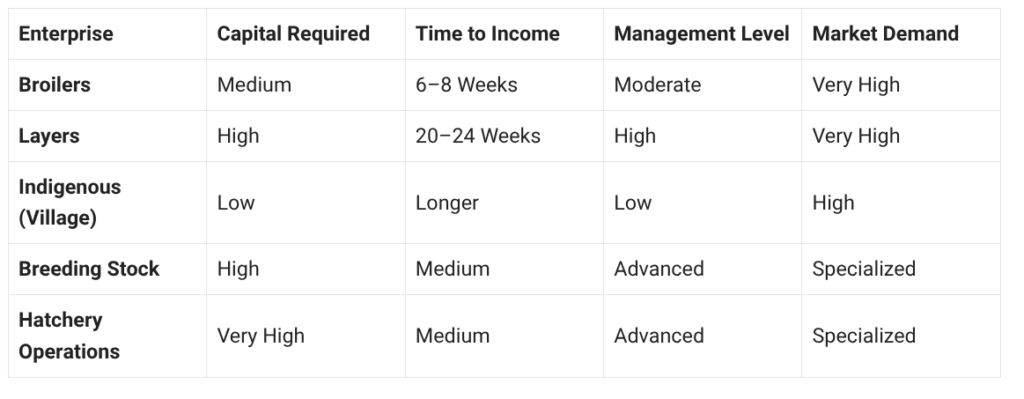
For most first-time farmers in Zambia, broiler production offers the quickest learning curve and the fastest opportunity to generate cash income. Layer farming is ideal for entrepreneurs looking for a continuous, steady monthly cash flow through daily egg sales, while indigenous chicken farming remains highly attractive for rural households operating with limited financial resources.
Poultry Housing Requirements
A well-designed poultry house provides birds with protection from extreme weather (such as Zambia’s heavy rainy season or the intense heat of October), predators, wild birds, and unnecessary stress. Poor housing layout often results in slow growth, higher mortality rates, increased feed consumption, and lower profits. Investing in proper housing from the beginning can significantly improve production performance.
Site Selection
The poultry house should be systematically located:
- On well-drained land to prevent waterlogging.
- Away from flood-prone areas.
- Easily accessible by road for feed deliveries and bird pickups.
- Close to a clean, reliable water source.
- Away from busy public roads and noise.
- At a safe distance from other poultry farms to minimize cross-contamination.
Good site selection directly reduces disease transmission and simplifies day-to-day farm operations.
Ventilation
Fresh air is essential for healthy birds. In Zambia, open-sided poultry houses covered with wire mesh and adjustable curtains are popular because they rely on natural airflow. Proper ventilation helps remove:
- Excess moisture from the litter.
- Harmful gases such as ammonia and carbon dioxide.
- Dust particles.
- Excess body heat during hot months.
Poor ventilation increases bird stress and makes the flock highly susceptible to chronic respiratory diseases (CRD).
Temperature Management
Young chicks cannot regulate their body temperature effectively during their first few weeks of life. During the critical brooding stage, Zambian farmers must maintain appropriate temperatures using charcoal brooders (mbaulas), gas brooders, or electric heating systems where a reliable power grid is available.
Signs that chicks are uncomfortable include:
- Crowding together near the heat source: The chicks are too cold.
- Moving far away from the heat source: The chicks are too hot.
- Uneven distribution throughout the brooder box: There is a temperature imbalance or an unwanted draft.
Observing bird behaviour is one of the best indicators of whether your brooding temperatures are appropriate.
Lighting
Lighting directly affects feeding behaviour, growth metrics, and egg production. Broilers generally require adequate lighting to encourage continuous feed intake during their early growth stages to maximize weight gain. Layer chickens require carefully managed artificial and natural lighting programmes to maintain consistent, optimal egg production throughout their laying cycle.
Stocking Density
Overcrowding is one of the leading causes of poor poultry performance and sudden mortality. Excessive stocking density can result in:
- Increased disease transmission.
- Severe heat stress (especially during hot, humid periods).
- Aggressive behaviour and cannibalism.
- Feather pecking.
- Poor weight gain and uneven flock sizes.
- Reduced egg production.
Farmers should always strictly follow recommended stocking densities based on bird age, breed, and housing type.
Biosecurity
Biosecurity refers to practical measures designed to prevent diseases from entering or spreading within the farm. Strong biosecurity is often far less expensive than treating disease outbreaks. Every poultry farm in Zambia should implement basic biosecurity practices, including:
- Restricting unnecessary visitors and keeping gates locked.
- Installing footbaths with disinfectant at all poultry house entrances.
- Cleaning and disinfecting equipment regularly.
- Isolating sick or weak birds immediately in a separate unit.
- Controlling rodents, wild birds, and flies.
- Purchasing day-old chicks exclusively from reputable, certified hatcheries.
Essential Poultry Equipment
Having the right equipment improves bird welfare, reduces labor requirements, prevents wastage, and increases production efficiency. Essential poultry equipment includes:
- Chick feeders & adult tube feeders
- Bell drinkers & automated nipple drinking systems
- Brooder rings, heat lamps, and charcoal brooders (mbaulas)
- Plastic egg trays & wooden nesting boxes for layers
- Secure feed storage bins to prevent dampness and pest access
- Wheelbarrows, shovels, and agricultural disinfectant sprayers
- Weighing scales (to track weekly broiler weight gain)
- Vaccination equipment (syringes, eye-droppers)
- Water storage tanks (such as a borehole-fed overhead tank)
- Generators or solar backup power systems for larger commercial operations
While small-scale farmers may begin with basic manual equipment, commercial farms often invest in automated feeding and watering systems to improve overall efficiency.
Feeding and Nutrition
Feed represents the single largest operating cost in poultry farming, often accounting for 60–70% of total production expenses. For this reason, good feed management is one of the most important factors influencing your profitability. Balanced nutrition supports healthy growth, efficient feed conversion ratios (FCR), disease resistance, and high egg production.
1. Starter Feed
Starter feed (Broiler Starter or Layer Starter) is specifically formulated for young chicks during the early stages of life (typically weeks 1 to 2 or 3). It contains high crude protein levels (usually around 21-23%), balanced vitamins, and essential minerals using easily digestible ingredients. Proper starter feeding lays a strong foundation for healthy skeletal and muscle growth.
2. Grower Feed
Grower feed supports steady, structural development after the intensive starter phase. Its nutrient composition encourages healthy skeletal growth and weight maintenance while preparing layer birds for their later production stages without making them overly fat.
3. Finisher Feed
Broilers receive finisher feed during the final weeks before being marketed. This ration contains slightly lower protein but higher energy levels designed to maximize muscle weight gain while maintaining efficient feed conversion.
4. Layer Mash
Layer mash is specifically formulated for laying hens once they reach maturity. It contains significantly increased calcium and phosphorus levels required for strong eggshell formation and consistent egg production. Providing layers with inadequate calcium can lead to thin-shelled eggs, egg-eating habits, and reduced flock productivity.
5. Clean Water
Water is often overlooked, yet it is the single most important nutrient in poultry production. Birds require continuous, unrestricted access to clean, fresh, and cool drinking water. Water containers and drinkers should be thoroughly cleaned daily to prevent bacterial growth and waterborne disease transmission.
6. Feed Storage
Poor feed storage can result in toxic mould growth, pest infestations, nutrient loss, and chemical contamination. Farmers should always:
- Store feed in cool, completely dry conditions.
- Keep feed bags stacked neatly on wooden pallets (never directly on the concrete floor).
- Protect feed storage rooms from rodents and insects.
- Rotate stock strictly using the “First In, First Out” (FIFO) method.
- Inspect feed regularly for unusual odours, caking, or spoilage.
Proper storage helps reduce costly waste and protects your flock’s health.
Common Poultry Breeds in Zambia
Choosing the right breed depends on your specific production goals. For meat production, commercial broiler strains dominate the Zambian industry due to their rapid growth and highly efficient feed conversion. Popular broiler breeds distributed locally include:
- Cobb (e.g., Cobb 500)
- Ross (e.g., Ross 308)
- Hubbard
For commercial egg production, many farmers choose high-performing, light-bodied commercial layer breeds valued for their high lay percentages and feed efficiency, such as:
- Lohmann Brown
- Hy-Line Brown
- ISA Brown
Farmers interested in dual-purpose production (both meat and eggs) or traditional systems may also rear indigenous or improved local breeds (such as SASSO or Kuroiler varieties), which are highly valued across Zambia for their local climate adaptability and premium market prices.
The best breed is not necessarily the fastest-growing or highest-producing—it is the specific breed that aligns directly with your management capacity, local feed availability, market demand, and business objectives.
Poultry Production Systems in Zambia
Choosing the right poultry production system is one of the most important decisions a farmer must make before starting a poultry business. The production system directly determines the amount of capital required, the level of daily management needed, overall production efficiency, and ultimately the long-term profitability of the farm.
In Zambia, poultry farmers deploy different systems depending on their specific production goals, available financial resources, land size, and target market. The main poultry production systems include free-range, semi-intensive, and intensive commercial systems.
🐓 Free-Range Poultry Farming System
The free-range system is one of the oldest and most traditional methods of poultry production in Zambia. It is most commonly practiced by small-scale farmers, especially across rural communities and villages.
Under this system, chickens are allowed to move around freely during the day while searching for insects, seeds, plants, and other natural sources of food. Farmers may provide additional supplementary feed and secure shelter, especially at night to keep the flock safe. Free-range farming is primarily used for indigenous (village) chickens because these breeds are naturally adapted to local environments.
Advantages of Free-Range Poultry Farming
- Low start-up costs: Minimal financial barriers to entry.
- Minimal housing requirements: Simple nighttime shelters are sufficient.
- Lower feed expenses: Birds find a large portion of their own food.
- Highly accessible: Perfectly suitable for small-scale and resource-constrained farmers.
- Hardy breeds: Indigenous chickens adapt exceptionally well to this open system.
- Reduced dependence: Less financial vulnerability to fluctuating commercial feed prices.
Challenges of Free-Range Poultry Farming
- Slow growth rates: Birds take much longer to reach optimal weight.
- Higher risk of predators: Flocks are vulnerable to hawks, dogs, and snakes.
- Increased disease exposure: Free-roaming birds easily pick up wild bird pathogens.
- Difficulties controlling breeding: Random mating makes trait selection impossible.
- Lower production volumes: Output is highly unpredictable and scattered.
- Limited market suitability: Not ideal for strict commercial markets.
Market Insight: For farmers targeting large-scale buyers, supermarkets, or modern restaurants, a purely free-range production system may not provide the consistent, high-volume output required.
🏡 Semi-Intensive Poultry Farming System
The semi-intensive system successfully combines elements of free-range and intensive commercial production. Birds are provided with permanent secure housing but also have designated access to fenced outdoor runs where they can move around, scratch, and feed naturally.
This system is becoming increasingly popular among emerging poultry farmers in Zambia because it provides a practical balance between initial capital investment and bird productivity.
Advantages of Semi-Intensive Farming
- Better disease control: Safer and more contained than completely open free-range systems.
- Improved growth rates: Controlled environments lead to more predictable weight gain.
- Reduced feed costs: Outdoor foraging supplements the diet and lowers the feed bill.
- Better bird management: Easier to monitor individual bird health and performance.
- Scale appropriate: Perfectly suited for medium-scale, emerging farmers.
Challenges of Semi-Intensive Farming
- Requires more land: Needs sufficient space to accommodate both the house and outdoor runs.
- Requires better management: Demands structural planning and regular flock monitoring.
- Lower relative production: Overall output is lower compared to fully automated intensive systems.
- Fencing infrastructure: Requires additional investment in secure perimeter fencing and outdoor management.
🏭 Intensive Commercial Poultry Farming System
The intensive system is the go-to choice for commercial poultry producers raising hundreds or thousands of birds at a time. In this system, chickens are kept completely enclosed in specially designed poultry houses where farmers strictly control all environmental variables:
- Feeding regimes
- Ambient temperature
- Lighting schedules
- Clean water supply
- Disease prevention and biosecurity
- Production cycles
Most large-scale commercial poultry operations in Zambia—including large broiler operations, commercial egg layer farms, hatchery operations, and breeder estates—rely exclusively on intensive production systems.
Advantages of Intensive Poultry Farming
- Maximum production levels: Yields the highest possible output per bird.
- Superior disease control: Enclosed spaces and strict biosecurity keep pathogens out.
- Rapid growth rates: Broilers convert feed efficiently and reach market weight quickly.
- Efficient space utilization: High stocking density optimizes land use.
- Easier record keeping: Simple to track daily feed intake, mortality, and egg counts.
- Commercial market ready: Provides the consistent volume required by premium retail chains.
Challenges of Intensive Poultry Farming
- High start-up costs: Substantial capital is needed for construction, automated fixtures, and initial stock.
- Requires technical knowledge: Demands a deep understanding of poultry science and husbandry.
- Total feed dependence: 100% reliant on purchased commercial feed formulations.
- Strict biosecurity demands: Any failure in biosecurity can expose a large flock to rapid infection.
- High risk exposure: Poor management can rapidly result in devastating financial losses.
📊 Choosing the Right Poultry Enterprise in Zambia
Before investing your hard-earned money, you must carefully choose the specific type of poultry business that matches your available resources, operational skills, and local market opportunities. There is no single poultry enterprise that is best for everyone; the right choice depends heavily on your capital, location, experience, and ultimate business goals.
1. Broiler Farming
Broiler production is often highly recommended for beginners because the chickens mature very quickly, allowing farmers to complete several distinct production cycles within a single calendar year. A farmer can easily start with a small batch, learn the ropes, and gradually reinvest profits to expand.
- Best Suited For: Beginners, youth entrepreneurs, small cottage businesses, and large-scale commercial operations.
- Main Income Source: Selling mature chickens directly for meat.
2. Layer Farming
Layer farming requires a higher degree of patience and cash reserves because the chickens do not begin producing eggs until they reach maturity after several months. However, once laying cycles begin, farmers receive a highly regular, predictable daily income from egg sales.
- Best Suited For: Farmers seeking continuous, long-term daily cash flow, agribusinesses supplying retail shops and public institutions, and larger agricultural enterprises.
- Main Income Sources: Table eggs, spent layers (off-layers sold for meat), and poultry manure sales.
3. Indigenous Chicken Farming
Indigenous (village) chicken production remains a highly resilient and lucrative opportunity for farmers across rural and peri-urban Zambia. Market demand for local chickens is incredibly strong and commands a premium because many consumers actively prefer their organic taste, firm texture, and traditional culinary value.
- Best Suited For: Rural households, small-scale farmers, and entrepreneurs operating with limited startup capital.
- Main Income Source: Selling live birds for specialized meat markets and traditional ceremonies.
📋 Critical Factors to Consider Before Starting
To prevent unexpected business failures, every aspiring poultry entrepreneur should analyze these four critical operational pillars before stocking their first batch:
Market Availability
A smart farmer always identifies and secures their target buyers before production begins. Never produce chickens without a reliable, verified market outlet, as holding mature birds past their prime leads to devastating feed losses.
- Potential Outlets: Local households, neighborhood restaurants, hotels, boarding schools, hospitals, commercial supermarkets, urban butcheries, and open-market wholesalers.
Availability of Feed
Because feed is consistently the largest operational cost in poultry production, you must map out reliable access to high-quality feed. Identify trusted suppliers for your specific enterprise needs—whether you require Starter feed, Grower feed, Finisher feed, or Layer mash. Remember that feed quality directly impacts your flock’s growth rate, daily egg output, mortality rates, and overall profit margins.
Access to Water and Electricity
Poultry require unrestricted access to clean, fresh drinking water every single day. Additionally, electricity is a core requirement for powering light fixtures, heating delicate young chicks during the brooding phase, running automated machinery, or operating incubators. If your local power grid is unreliable, you must proactively plan for backup solutions like generators or solar power systems.
Availability of Technical Knowledge
Many Zambian poultry businesses fail because owners underestimate the level of daily management required. To succeed, you must thoroughly understand feeding programmes, strict vaccination schedules, disease prevention protocols, precise record keeping, and housing management. Seeking training from agricultural extension officers or shadowing experienced local farmers can greatly improve your success rate.
🏗️ Poultry Housing Requirements in Zambia
A well-constructed poultry house is the absolute foundation of a successful operation. It protects your birds from extreme temperature fluctuations, heavy rains, strong winds, predators, and disease exposure, creating a stable environment where chickens can grow efficiently.
Selecting the Location for a Poultry House
Your chosen site must possess:
- Good drainage: To keep the structure dry and prevent waterlogging.
- Reliable water supply: Close to high-yield boreholes or clean water sources.
- Easy access roads: For smooth delivery of feed and pickup of mature stock.
- Adequate space: To allow for seamless future expansion.
- Biosecure distance: Positioned away from neighboring poultry farms to limit airborne disease transfer.
- Avoid flood-prone areas or locations blocked from natural wind paths.
Poultry House Design Considerations
- Ventilation: Good airflow is mandatory to remove excess body heat, harmful ammonia gases, and airborne moisture. Poorly ventilated houses trap ammonia, leading to severe respiratory infections and high mortality.
- Temperature Control: Day-old chicks cannot self-regulate their temperature and require external warmth. Farmers must use functional tools like specialized brooders, infrared heat lamps, gas brooders, or charcoal brooders (mbaulas) to keep chicks comfortable.
- Lighting: Light exposure directly drives bird activity, feed consumption patterns, and egg production. Commercial layer farms must manage artificial lighting schedules precisely to maintain peak egg-laying percentages.
- Stocking Density: Overcrowding is a leading cause of flock failure. Putting too many birds in a tight space leads to severe stress, cannibalism, feather pecking, rapid disease outbreaks, poor weight gain, and increased mortality. Always build according to your targeted flock size.
🛠️ Essential Poultry Equipment
The specific tools you need depend heavily on the scale and type of your poultry operation. While small-scale backyard farmers can easily excel using basic manual equipment, large-scale commercial setups rely on automated systems to optimize efficiency.
Basic Poultry Equipment
Ideal for small-scale and emerging operations:
- Chick feeders and adult tube feeders
- Manual font drinkers and bell drinkers
- Brooder rings, heat lamps, and charcoal heaters
- Chick guards (to keep chicks close to the heat source)
- Plastic egg trays and sturdy wooden nest boxes for layers
- Weighing scales to monitor growth rates
- Durable feed storage containers
Commercial Poultry Equipment
Deployed by large-scale intensive farms to maximize throughput:
- Automated chain or auger feeding systems
- Automated nipple drinking lines
- Large-scale commercial incubators and hatchers
- Automated climate control and sensor systems
- Mechanical egg collection conveyor systems
- Industrial ventilation fans and cooling pads
- Automated, timer-controlled lighting rigs
Importance of Quality Equipment
Investing in reliable, high-quality equipment pays off by significantly reducing feed wastage, improving coop hygiene, saving expensive labor hours, boosting overall production efficiency, and drastically lowering disease risks. Buying durable equipment may appear more expensive initially, but it directly protects your profit margins and ensures long-term business viability.