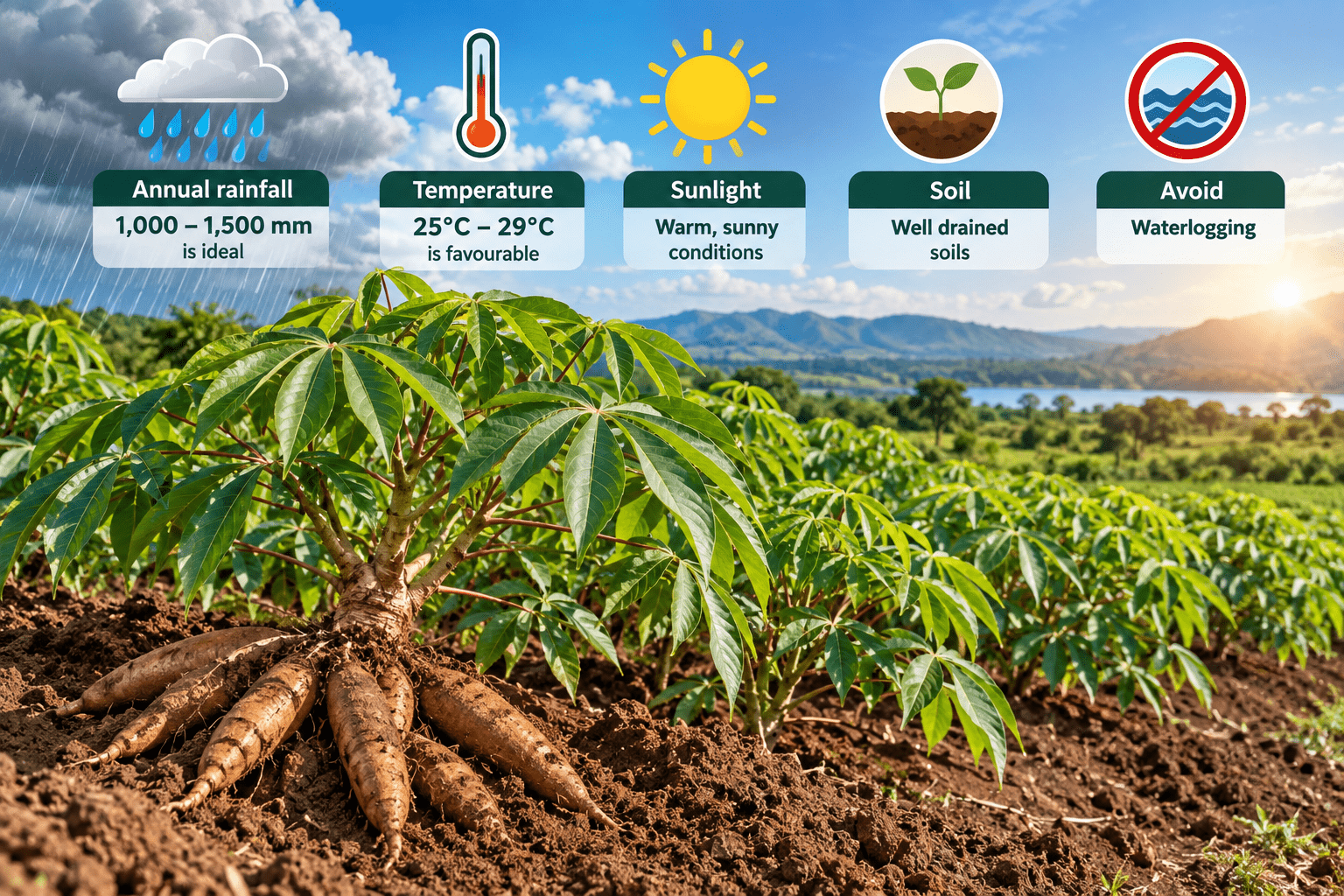
Climate requirements for growing cassava in Zambia are generally favourable because cassava performs well under warm tropical conditions and can tolerate periods of drought better than many staple crops. For good root development and higher yields, however, farmers should aim for temperatures of about 25°C to 29°C, annual rainfall of approximately 1,000–1,500 mm, sufficient moisture during establishment and well-drained soils.
Understanding climate is only one part of successful production. For the complete production process, including land preparation, varieties, planting, fertilisation, weed control, harvesting and marketing, see our full guide to Cassava Farming in Zambia.
Cassava’s ability to survive variable rainfall makes it particularly valuable in Zambia, where rainfall conditions differ considerably between the northern, central and southern parts of the country.
What Climate Does Cassava Need?
Cassava is a tropical crop that prefers a warm, frost-free growing environment.
The International Institute of Tropical Agriculture (IITA) recommends areas receiving preferably 1,000 mm or more of annual rainfall, with at least six months receiving approximately 50 mm or more of rain per month.
FAO guidance indicates that cassava performs particularly well at average temperatures of approximately 25°C–29°C and with annual rainfall around 1,000–1,500 mm, although the crop can survive considerably drier conditions.
A useful general guide for Zambian farmers is:
| Climate factor | Suitable conditions for cassava |
|---|---|
| Temperature | About 25°C–29°C is favourable |
| Annual rainfall | About 1,000–1,500 mm is ideal |
| Minimum rainfall tolerance | Cassava can survive around 500 mm under some conditions |
| Rain distribution | Good rainfall during establishment is important |
| Sunlight | Warm, sunny tropical conditions |
| Frost | Should be avoided |
| Waterlogging | Poorly tolerated |
| Drought | More tolerant than many staple crops |
Cassava should not, however, be considered completely drought-proof. Severe moisture stress, particularly soon after planting, can reduce establishment, plant growth and eventual root yield.
Temperature Requirements for Cassava
Cassava grows best in warm conditions.
An average temperature of approximately 25°C to 29°C provides favourable conditions for vegetative growth and root development. FAO notes that cassava growth can stop when temperatures fall below approximately 10°C.
Fortunately, temperatures in many cassava-producing areas of Zambia remain suitable during much of the growing season.
Lower temperatures during Zambia’s cool season, particularly in June and July, can slow cassava growth. This normally does not kill established plants, but growth may be considerably slower than during the warmer rainy season.
Very high temperatures combined with severe moisture shortages can also stress cassava plants.
For this reason, temperature should always be considered together with rainfall and soil moisture rather than in isolation.
How Much Rainfall Does Cassava Need?
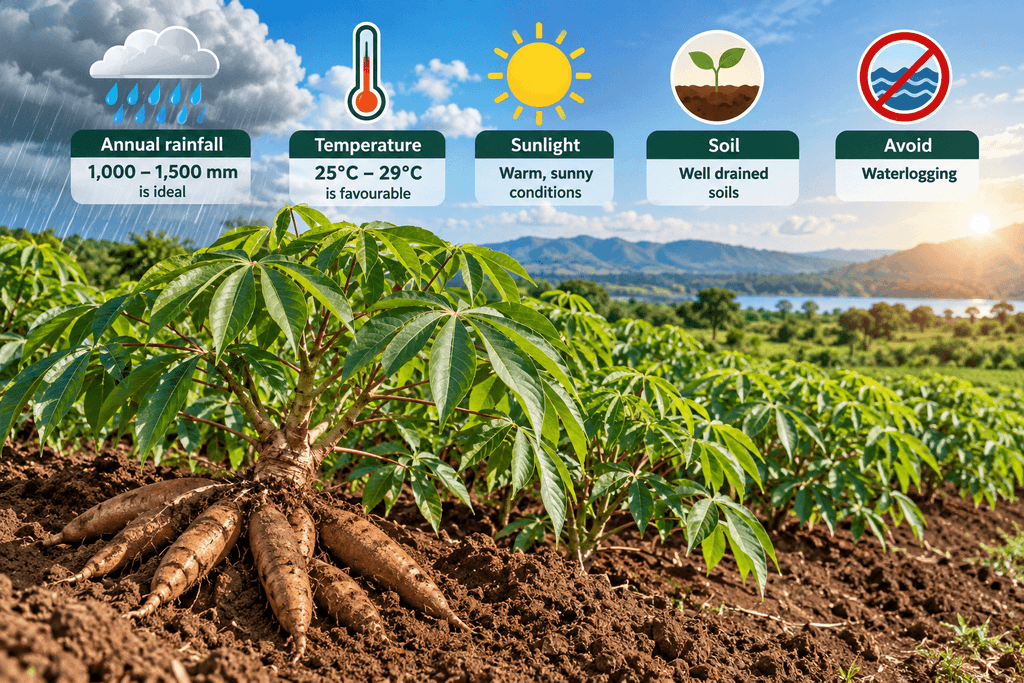
Cassava grows particularly well where annual rainfall is around 1,000–1,500 mm and reasonably well distributed.
This explains why cassava has traditionally been particularly important in Zambia’s wetter northern regions.
IITA recommends preferably at least 1,000 mm of rainfall annually, with approximately six or more months of meaningful rainfall during the growing period.
However, one of cassava’s greatest advantages is its drought tolerance.
Older FAO guidance indicates that cassava can survive environments receiving rainfall as low as approximately 500 mm annually, although production under such conditions does not necessarily represent optimum growing conditions.
During extended dry periods, cassava can reduce its growth considerably and later resume stronger growth when favourable moisture conditions return.
This ability makes cassava an important crop for farmers looking to diversify away from crops that are much more vulnerable to drought.
Cassava Still Needs Rain When Establishing
Cassava may be drought tolerant once established, but newly planted cassava cuttings require adequate soil moisture.
This distinction is important.
A farmer should not plant cassava into extremely dry soil simply because cassava is regarded as drought tolerant.
Freshly planted stem cuttings need moisture to:
- develop roots;
- produce shoots;
- establish a healthy plant;
- replace water lost from the cutting; and
- prepare the plant for later periods of moisture stress.
Poor rainfall immediately after planting can therefore result in weak establishment or missing plants.
For rain-fed cassava farming in Zambia, planting around the beginning of reliable seasonal rains is generally safer than planting long before adequate soil moisture becomes available.
Cassava and Zambia’s Agro-Ecological Regions
Zambia is commonly divided into three broad agro-ecological regions based largely on rainfall and other growing conditions.
These differences help explain why cassava production has historically been concentrated more heavily in some provinces than others.
Agro-Ecological Region III
Region III generally receives approximately 1,000–1,500 mm or more of rainfall annually, making much of this zone highly suitable for rain-fed cassava production.
The region covers much of northern Zambia.
For example, the Ministry of Agriculture describes Luwingu in Northern Province as lying within Agro-Ecological Region III, where annual rainfall is generally between 1,000 and 1,500 mm.
These wetter conditions help explain the traditional importance of cassava in provinces such as:
- Luapula;
- Northern;
- Muchinga; and
- North-Western.
ZamStats data from the 2021/22 agricultural season showed particularly high participation in cassava production among agricultural households in Luapula and Northern provinces.
High rainfall does introduce another problem, however: waterlogging.
Cassava roots require sufficient oxygen in the soil. Fields that remain saturated for extended periods can develop poor root growth and root rot.
Farmers in very wet areas should therefore prioritise drainage and consider ridges or mounds where necessary.
Agro-Ecological Region II
Much of central Zambia falls within Region II, where annual rainfall generally ranges from approximately 800–1,000 mm.
This includes large parts of Central, Eastern, Lusaka and Southern provinces.
The Ministry of Agriculture notes that dry spells can occur within this region even during the rainy season.
Cassava can still be grown successfully under these conditions because of its drought tolerance, but establishing the crop properly becomes particularly important.
Farmers should:
- plant when dependable rains have begun;
- conserve soil moisture;
- control weeds early;
- avoid unnecessarily disturbing the soil; and
- use varieties suited to local conditions.
Agro-Ecological Region I
Region I is considerably drier, generally receiving approximately 600–800 mm of rainfall annually, with a shorter and less reliable growing season.
Cassava’s drought tolerance gives it potential in some of these areas, but yields can be limited where rainfall is very low or poorly distributed.
Successful production in drier parts of Zambia therefore depends more heavily on good establishment, moisture conservation, appropriate varieties and suitable soil.
Why Cassava Is Particularly Suitable for Northern Zambia
Cassava has traditionally been strongly associated with Northern and Luapula provinces, although production is increasingly spreading to other parts of Zambia.
The Ministry of Agriculture reports that cassava, traditionally concentrated in Northern and Luapula, has expanded into provinces including Copperbelt, Western, Eastern and Southern.
Several climatic factors favour northern Zambia.
The region generally has:
- a longer rainy season;
- relatively high annual rainfall;
- warm growing conditions;
- fewer prolonged droughts than southern Zambia; and
- climatic conditions suitable for long-duration crops.
Cassava also tolerates relatively acidic and lower-fertility soils better than many crops.
Rainfall alone, however, does not guarantee a good cassava harvest. Farmers must still pay attention to drainage, soil fertility, disease-free planting material and appropriate varieties.
Can Cassava Grow in Drought-Prone Parts of Zambia?
Cassava can grow in relatively drought-prone areas and is generally more drought tolerant than crops such as maize.
This makes cassava increasingly important as farmers adapt to rainfall variability.
The crop survives dry conditions partly by reducing its growth and water use during periods of severe moisture shortage. When rainfall returns, established cassava plants can resume growth.
However, drought can still reduce yields.
The greatest risks normally occur when:
- cuttings are planted into very dry soil;
- drought occurs before plants have established;
- soils have very low water-holding capacity;
- prolonged moisture stress occurs during root development; or
- unsuitable varieties are planted.
Farmers should therefore distinguish between cassava’s ability to survive drought and its requirements for achieving high yields.
A cassava plant may survive conditions under which maize fails, but the highest cassava yields still require adequate moisture.
Does Cassava Tolerate Heavy Rainfall?
Cassava can grow in high-rainfall environments, but it does not tolerate prolonged waterlogging well.
This is particularly important in parts of northern Zambia.
IITA recommends well-drained soils for cassava and advises using mounds or sufficiently high ridges where waterlogging is a problem.
Too much standing water around cassava roots can contribute to:
- poor root development;
- oxygen deficiency around the roots;
- root rotting;
- increased disease problems; and
- poor-quality storage roots.
Farmers in high-rainfall locations should therefore select fields with good natural drainage whenever possible.
Best Time to Plant Cassava in Zambia
For rain-fed farming, cassava should generally be planted after sufficient rains have moistened the soil at the beginning of the rainy season.
There is no single planting date that applies to the whole country because Zambia’s rainfall onset differs between regions and from one season to another.
The most important consideration is soil moisture.
A farmer should have enough moisture in the soil to allow planted stem cuttings to establish successfully.
Planting too early, before dependable rains arrive, increases the possibility of cuttings drying out.
Planting excessively late can shorten the period during which young plants benefit from rainy-season moisture.
Farmers should therefore base planting decisions on actual local rainfall conditions rather than simply following a fixed calendar date every year.
Soil Moisture and Drainage Are Just as Important as Rainfall
A location can receive sufficient annual rainfall and still be unsuitable for cassava if the soil remains waterlogged.
Similarly, an area receiving moderate rainfall may produce good cassava if its soil stores moisture effectively.
The ideal cassava soil is therefore:
- deep;
- well drained;
- reasonably loose;
- capable of holding some moisture;
- free from prolonged flooding; and
- deep enough for storage roots to expand.
FAO identifies deep, well-drained and relatively light-textured soils as particularly suitable for cassava, with an optimum soil pH of approximately 4.5–6.5.
Cassava’s ability to tolerate relatively poor soils does not mean that soil conditions are unimportant. Fertility, drainage and soil structure can substantially affect final yield.
Climate and soil conditions work together when determining how well cassava will perform. Even in areas with suitable rainfall and temperatures, poor drainage, compaction or unsuitable soil texture can reduce root development. See our guide to Best Soil for Cassava Farming in Zambia for a detailed look at soil type, pH, drainage and fertility requirements.
Climate Change and Cassava Production in Zambia
Zambian farmers increasingly have to plan around irregular rainfall, delayed rainfall onset, dry spells and extreme weather.
The Ministry of Agriculture Zambia has identified rising temperatures and increasingly erratic rainfall as important risks to Zambian agriculture, particularly because much of the country’s crop production remains dependent on rainfall.
Cassava can form part of a climate-resilient farming strategy because of its ability to survive dry periods better than many crops.
Farmers should nevertheless improve resilience by:
- planting healthy and suitable cassava varieties;
- planting when adequate moisture is available;
- maintaining organic matter in the soil;
- controlling weeds early;
- reducing unnecessary moisture loss;
- avoiding waterlogged fields; and
- diversifying rather than depending on a single crop.
Cassava should therefore be viewed as a climate-resilient crop rather than a crop completely unaffected by climate conditions.
Which Parts of Zambia Have the Best Climate for Cassava?
From a climate perspective, many areas receiving adequate rainfall and warm temperatures can support cassava production.
The traditionally important cassava-growing provinces include:
- Luapula Province;
- Northern Province;
- Muchinga Province;
- North-Western Province; and
- Western Province.
However, cassava production is not limited to these areas.
Government has reported expansion of cassava production into other provinces, including Copperbelt, Eastern and Southern Zambia.
Whether cassava will perform well on a particular farm depends on more than the province itself. Local rainfall, soil type, drainage, variety selection and farming practices can create major differences even within the same district.
Quick Guide: Ideal Cassava Climate in Zambia
For farmers assessing whether their area is suitable for cassava, the following conditions provide a useful benchmark:
Temperature: Around 25°C–29°C is highly favourable.
Rainfall: Approximately 1,000–1,500 mm annually is favourable, particularly when rainfall is reasonably distributed.
Drought: Cassava tolerates drought better than many staple crops, but severe drought can reduce yields.
Planting moisture: Good soil moisture during establishment is essential.
Drainage: Avoid fields that remain waterlogged for long periods.
Sunlight: Cassava requires warm, sunny growing conditions.
Growing season: A long warm season allows plants enough time to develop substantial storage roots.
Frequently Asked Questions
What is the best temperature for growing cassava in Zambia?
The best temperature for growing cassava in Zambia is generally around 25°C to 29°C. Cassava prefers consistently warm tropical conditions, while prolonged cold conditions slow plant growth.
How much rainfall does cassava need in Zambia?
Cassava needs approximately 1,000–1,500 mm of well-distributed annual rainfall for favourable growth, although the crop can tolerate significantly drier conditions after establishment. Adequate rainfall at planting is especially important.
Can cassava grow in dry areas of Zambia?
Cassava can grow in dry areas of Zambia because it is relatively drought tolerant. However, successful establishment requires moisture, and prolonged severe drought can substantially reduce root yields.
Can cassava grow in areas with heavy rainfall?
Cassava can grow in areas with heavy rainfall provided the soil drains properly. Prolonged waterlogging can damage roots, so farmers in wet areas may need to plant on ridges or mounds.
Which province in Zambia is best for cassava farming?
There is no single province that is automatically best for every cassava farm, but Luapula and Northern provinces are among Zambia’s most important traditional cassava-producing areas. Muchinga, North-Western and Western provinces also have significant cassava production. Suitable conditions can also occur in other parts of Zambia.
Is cassava more drought tolerant than maize?
Cassava is generally more drought tolerant than maize, particularly after the crop has become established. This makes it useful for crop diversification in areas affected by unpredictable rainfall. However, adequate moisture still increases cassava growth and root yields.
Final Thoughts
The main climate requirements for growing cassava in Zambia are warm temperatures, adequate moisture during establishment, sufficient seasonal rainfall and soils that do not remain waterlogged.
Conditions of approximately 25°C–29°C and 1,000–1,500 mm of annual rainfall are particularly favourable, but cassava’s ability to tolerate considerably drier environments allows it to be cultivated across a much wider part of Zambia.
Northern and Luapula provinces naturally provide particularly favourable rainfall conditions, but cassava production can extend well beyond the traditional growing areas when farmers select appropriate varieties and manage soil moisture properly.
For anyone planning commercial or household cassava production, climate should therefore be considered together with soil type, variety selection, planting time, disease management and market requirements rather than as an isolated factor.