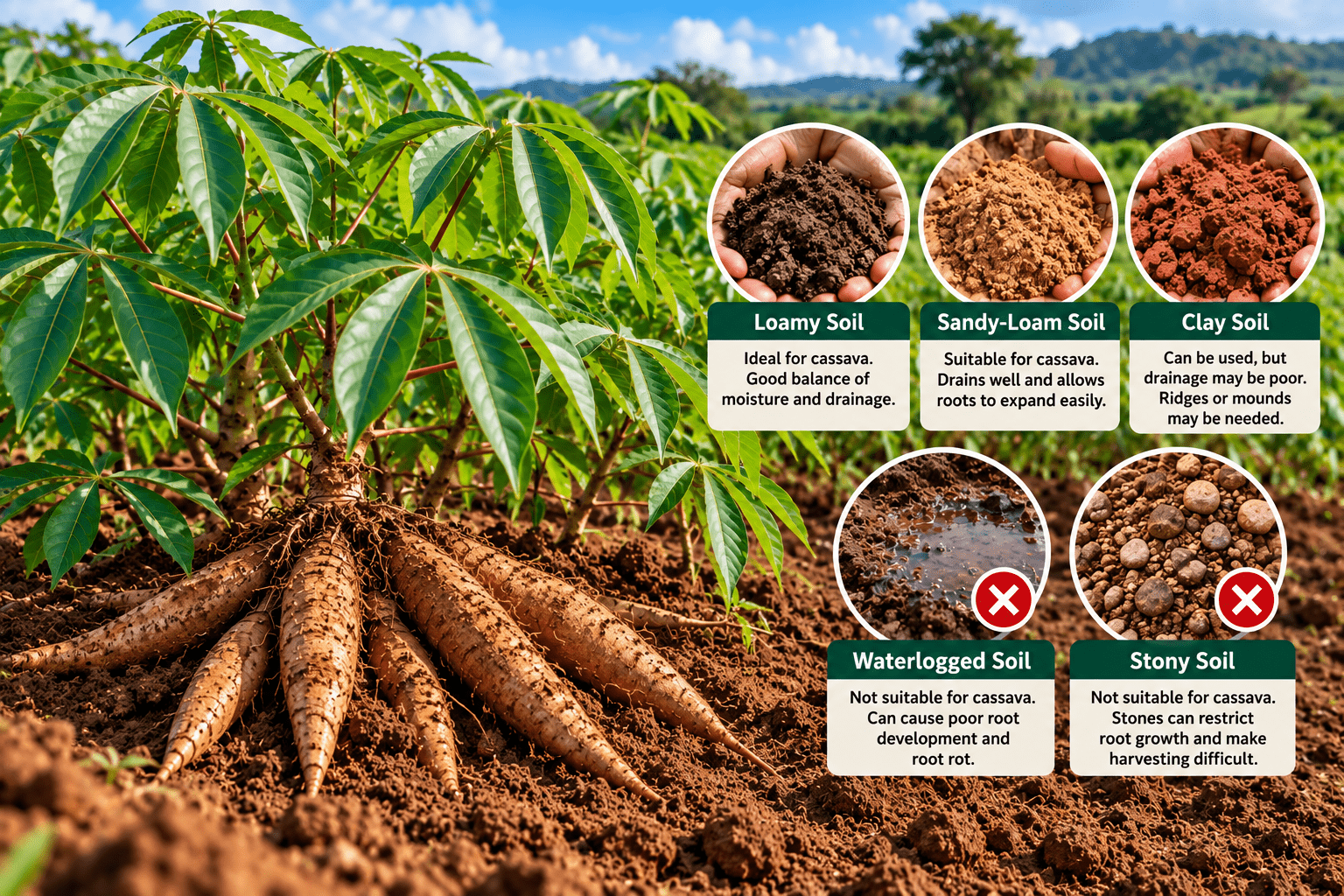
The best soil for cassava farming in Zambia is deep, loose, well-drained loamy or sandy-loam soil that allows cassava roots to expand easily while retaining enough moisture to support plant growth. Cassava can survive in relatively poor soils, but good soil conditions can make a major difference to root size, yield and harvesting.
Farmers planning to grow cassava commercially or for household production should therefore assess the soil before planting. For the complete production process, including land preparation, planting, varieties, crop management and harvesting, see our main guide to Cassava Farming in Zambia.
What Type of Soil Is Best for Cassava?
Cassava performs best in soils that are:
- deep;
- loose and friable;
- well drained;
- reasonably fertile;
- low in stones and gravel;
- capable of holding some moisture; and
- free from hard layers that restrict root development.
The International Institute of Tropical Agriculture (IITA) recommends well-drained soils that are not extremely shallow or stony, while FAO describes deep, light-textured and well-drained soils as particularly suitable for cassava.
In practical terms, loamy and sandy-loam soils are among the best options for cassava production.
These soils provide a useful balance between moisture retention and drainage while remaining loose enough for the storage roots to expand.
Why Loose Soil Is Important for Cassava
Unlike crops grown mainly for leaves or grain, cassava produces its economically important crop underground.
The soil must therefore provide enough space for the storage roots to enlarge.
Loose soil allows:
- roots to penetrate easily;
- storage roots to expand;
- better movement of air through the soil;
- excess water to drain away; and
- easier harvesting.
Compacted soil can restrict root development and lead to poorly shaped or smaller cassava roots.
A deep, friable soil is therefore particularly valuable where farmers are targeting high yields or supplying roots to processors and commercial markets.
Loamy Soil
Loamy soil is generally one of the most suitable soil types for cassava.
Loam contains a useful mixture of sand, silt and clay, giving it characteristics that favour cassava production.
Good loamy soil normally:
- holds adequate moisture;
- drains excess water;
- contains useful organic matter;
- allows air movement around roots; and
- is relatively easy for storage roots to penetrate.
IITA guidance specifically identifies deep, well-drained loamy soil as highly suitable for cassava farming.
Farmers who have access to such soils are generally starting with favourable physical conditions for the crop.
Sandy-Loam Soil
Sandy-loam soil can also be excellent for cassava.
Its relatively loose structure makes it easier for roots to expand and simplifies harvesting.
FAO identifies well-drained sandy clay loam as suitable for cassava and notes that the crop generally performs well in soils with good drainage.
However, extremely sandy soil can create problems.
Very sandy soils may:
- lose water quickly;
- lose nutrients through leaching;
- require more careful fertility management; and
- expose the crop to moisture stress during long dry periods.
The objective is therefore not simply to find the sandiest soil possible.
A sandy-loam soil containing enough organic matter to retain moisture and nutrients is generally preferable to almost pure sand.
Can Cassava Grow in Clay Soil?
Cassava can grow in some clay soils, but heavy clay is usually less suitable than lighter, well-drained soil.
Heavy clay can become sticky and waterlogged during periods of high rainfall and extremely hard when it dries.
This can restrict:
- root expansion;
- soil aeration;
- drainage; and
- harvesting.
IITA notes that cassava does not thrive particularly well in extremely clayey or waterlogged soils.
Farmers with heavier soils should pay particular attention to drainage and soil structure.
Planting on properly constructed ridges or mounds can help raise the developing roots above poorly drained soil.
Avoid Waterlogged Soils
Waterlogging is one of the most important soil problems to avoid when selecting land for cassava.
Cassava needs moisture, but its roots also require oxygen.
When soil remains saturated for prolonged periods, there is very little air around the roots.
This can contribute to:
- root rot;
- poor root development;
- weakened plants;
- reduced yields; and
- deterioration of harvested root quality.
IITA specifically recommends raised mounds or sufficiently high ridges where cassava must be grown on land that is prone to waterlogging.
This is especially relevant in Zambia’s wetter cassava-producing areas where heavy rains can temporarily saturate poorly drained fields.
The better option, where possible, is to select naturally well-drained land before planting.
Best Soil pH for Cassava
Cassava tolerates acidic soils better than many crops, which is one reason it performs relatively well in parts of Zambia with naturally acidic soils.
FAO gives an optimum cassava soil pH of approximately 4.5 to 6.5, although another FAO reference identifies about 5.5 to 6.5 as a preferred range for good production.
A practical target for many farmers is therefore roughly:
| Soil pH | General suitability |
|---|---|
| Below 4.5 | Strongly acidic; soil testing and corrective management may be necessary |
| 4.5–5.5 | Cassava can generally tolerate this range |
| 5.5–6.5 | Very favourable range for cassava |
| Above 7.0 | Increasing alkalinity may affect nutrient availability |
Cassava’s tolerance of acidity should not be confused with complete immunity to soil-acidity problems.
Very acidic soils can reduce the availability of important nutrients, particularly phosphorus.
Research involving cassava production at Mansa in Zambia has, for example, highlighted soil acidity as one factor capable of limiting nutrient availability and crop response even where nutrients are present.
Why a Soil Test Is Worth Doing
Farmers planning larger cassava fields should consider soil testing before making major fertiliser or lime applications.
A soil test can provide information about:
- soil pH;
- nitrogen;
- phosphorus;
- potassium;
- organic matter; and
- possible soil acidity problems.
This allows fertiliser or soil amendments to be based on the actual condition of the field rather than guesswork.
This is particularly useful for commercial cassava production because cassava removes significant quantities of nutrients when large quantities of roots are harvested.
Cassava Can Grow in Poor Soil — But That Does Not Mean Poor Soil Is Best
Cassava is often described as a crop that grows on poor soils.
That statement is partly true but can also be misleading.
Cassava is relatively tolerant of low soil fertility and can continue producing under conditions where some other crops struggle. FAO describes the crop as adaptable to relatively poor soils, while IITA notes that cassava can grow across a wide range of soil conditions.
However, cassava surviving in poor soil is not the same as cassava producing its maximum yield.
Higher cassava yields require sufficient nutrients.
IITA notes that cassava requires substantial nutrient supplies when farmers are targeting high yields and that repeated production without replacing removed nutrients can gradually impoverish the soil.
A farmer should therefore avoid thinking:
Cassava grows in poor soil, so soil fertility does not matter.
A better principle is:
Cassava tolerates poor soils better than many crops, but fertile and well-managed soils generally produce stronger plants and higher yields.
Organic Matter Can Improve Cassava Soil
Adding organic matter can improve soils used for cassava production.
Suitable sources may include:
- properly decomposed animal manure;
- compost;
- crop residues;
- green manures; and
- other locally available organic materials.
Organic matter can improve:
- soil structure;
- moisture retention;
- biological activity;
- nutrient availability; and
- the ability of sandy soils to hold water.
Organic materials should preferably be incorporated as part of a broader soil-fertility strategy rather than relying on extremely large quantities of fresh manure immediately around cassava cuttings.
Potassium Is Particularly Important for Cassava
Cassava produces large quantities of carbohydrate-rich storage roots.
As a result, potassium is an especially important nutrient for root development and overall productivity.
Cassava can remove substantial amounts of potassium from the soil when roots are harvested repeatedly.
Nitrogen and phosphorus are also important, but farmers should avoid excessive nitrogen application.
Very high soil fertility, particularly excessive nitrogen, can encourage vigorous stem and leaf growth without providing a corresponding increase in storage-root production. FAO notes that excessively fertile conditions can sometimes favour above-ground growth at the expense of root growth.
Fertiliser should therefore be balanced according to soil conditions and production objectives.
Check Soil Depth Before Planting
Cassava should preferably be planted in reasonably deep soil.
IITA recommends soils that are not extremely shallow and gives approximately 30 cm as a minimum useful soil depth in its cassava production guidance.
Deeper soil is generally preferable because cassava roots need sufficient space to expand.
Avoid fields where a shallow layer of soil sits directly above:
- solid rock;
- compacted gravel;
- an impermeable clay layer; or
- a hardpan.
A hardpan can prevent roots from penetrating deeper into the soil and may also interfere with drainage.
Stones and Gravel Can Reduce Root Quality
Fields containing large quantities of stones or gravel are less suitable for cassava.
Stones can obstruct developing roots and cause irregular root shapes.
They can also make land preparation and harvesting considerably more difficult.
IITA advises against extremely stony soils, while FAO also identifies gravelly soils as less suitable for cassava production.
This becomes particularly important when cassava is being grown commercially and farmers want large, well-shaped roots that are easier to harvest and process.
Watch for Compacted Soil and Hardpans
Compaction can occur through:
- repeated movement of heavy machinery;
- livestock traffic;
- repeated cultivation at the same depth; or
- natural soil conditions.
A compacted layer beneath the surface can behave almost like a barrier.
Cassava roots may spread sideways rather than developing normally, while drainage may also deteriorate.
Farmers preparing new land should investigate whether there is a hard layer beneath the surface rather than judging the field only by the topsoil.
How to Check Soil Texture by Hand
A simple field test can provide a rough indication of soil texture.
Take a small amount of moist soil and squeeze it in your hand.
Loamy soil: It can normally form a loose ball but breaks apart relatively easily when pressed.
Sandy soil: It feels gritty and may struggle to hold together.
Clay soil: It feels sticky when wet and usually forms a firm ball that does not break apart easily.
IITA describes a similar hand-testing approach for identifying loamy, sandy and clayey soils when selecting cassava land.
This simple test cannot replace laboratory analysis, but it can help farmers compare different fields before deciding where to plant.
Red Soils Can Be Suitable for Cassava
Many farmers in Zambia encounter red or reddish-brown soils.
Colour alone does not determine whether a soil is suitable for cassava.
What matters more is:
- drainage;
- depth;
- texture;
- fertility;
- organic matter;
- pH; and
- compaction.
A deep red loamy soil with good drainage may be very suitable for cassava.
By contrast, a red soil that is severely compacted, extremely acidic or shallow may require considerable management before it produces good yields.
Soil Requirements in High-Rainfall Areas
In high-rainfall cassava-producing areas such as parts of Northern and Luapula provinces, drainage becomes especially important.
Good rainfall can support strong cassava growth, but excess water can become a problem where soil drainage is poor.
Farmers in these environments should favour:
- gently sloping or naturally drained fields;
- deep soils;
- ridges or mounds where required;
- good drainage channels where appropriate; and
- fields without prolonged standing water.
Poorly drained depressions and low-lying wet areas should generally be avoided.
Soil Requirements in Drier Parts of Zambia
In areas receiving lower or more erratic rainfall, the challenge changes from disposing of excess water to conserving moisture.
Farmers should favour soils that:
- drain properly without drying excessively quickly;
- contain adequate organic matter;
- can store rainfall;
- are deep enough for root development; and
- are protected from unnecessary erosion and moisture loss.
Extremely sandy soils may require additional organic matter because they can lose moisture rapidly during dry periods.
This is one reason soil management should always be considered together with the climate requirements for growing cassava in Zambia.
Ridges, Mounds or Flat Planting?
Cassava can be planted on flat land, ridges or mounds depending on soil and rainfall conditions.
Flat planting
Flat planting can work well where:
- the soil is deep;
- drainage is naturally good;
- the field is not prone to flooding; and
- soil is sufficiently loose.
Ridges
Ridges can be useful where:
- drainage needs improvement;
- soil is relatively heavy;
- farmers want easier harvesting; or
- rainfall is relatively high.
Mounds
Mounds can be particularly useful where:
- local soils are prone to waterlogging;
- traditional farming systems favour mound cultivation; or
- farmers need to raise developing roots above saturated soil.
The planting system should therefore respond to the actual field rather than being applied automatically everywhere.
How to Select a Good Cassava Field
Before planting cassava, walk through the field and assess several characteristics.
A good field should preferably have:
- Deep soil – enough space for storage roots to expand.
- Good drainage – rainwater should not remain standing for long periods.
- Loose soil structure – roots should be able to penetrate the soil easily.
- Few stones – excessive stones can interfere with root growth and harvesting.
- Reasonable fertility – cassava tolerates poor soils, but yields benefit from sufficient nutrients.
- Suitable pH – approximately 5.5–6.5 is particularly favourable.
- No severe hardpan – compact layers can restrict root development.
- Good moisture retention – particularly important in drier areas.
The presence of healthy vegetation can also provide a useful first indication that the land has reasonable fertility and biological activity, although proper soil assessment gives a much clearer picture.
Improving Poor Soil Before Planting Cassava
A field does not necessarily need to be abandoned because its soil is imperfect.
Depending on the problem, farmers may improve it through:
Low organic matter: Add compost, manure or retained crop residues.
Poor drainage: Construct suitable ridges, mounds or drainage channels.
Compaction: Loosen the soil deeply before planting where practical.
Very acidic soil: Conduct a soil test before deciding whether lime is needed.
Low fertility: Apply nutrients according to soil-test results and local agronomic recommendations.
Sandy soil: Increase organic matter and use practices that conserve moisture.
Erosion: Use contour farming, ground cover and other soil-conservation practices.
The correct intervention depends on the actual limitation.
Protect the Soil After Establishing the Crop
Good soil management should continue after planting.
Cassava fields can remain in the ground for many months, leaving plenty of time for erosion, nutrient depletion and weed problems to develop.
Farmers can protect the soil by:
- keeping erosion under control;
- maintaining organic matter;
- controlling weeds;
- avoiding unnecessary burning of crop residues;
- rotating cassava with other crops;
- using legumes where appropriate; and
- replacing nutrients removed during harvesting.
Crop rotation becomes particularly important when cassava is repeatedly grown on the same field.
Continuous cassava production without replacing nutrients can gradually reduce soil fertility.
Quick Soil Checklist for Cassava Farmers
Before committing a field to cassava, check the following:
| Factor | What to look for |
|---|---|
| Soil texture | Loam or sandy loam |
| Drainage | Good; no prolonged standing water |
| Soil depth | Preferably deep; avoid shallow soils |
| pH | Around 5.5–6.5 is very favourable |
| Compaction | No major hardpan |
| Stones | Few stones or gravel |
| Organic matter | Moderate to high is beneficial |
| Moisture holding | Enough to support the crop through dry spells |
| Fertility | Adequate and preferably confirmed through soil testing |
Final Thoughts
The best soil for cassava farming in Zambia is not simply the most fertile soil available. Cassava performs particularly well where the soil combines good drainage, sufficient depth, loose structure, adequate moisture retention and reasonable fertility.
Deep loamy and sandy-loam soils are especially suitable because they allow the storage roots to expand while preventing prolonged waterlogging.
Cassava’s ability to tolerate acidic and relatively infertile soils gives Zambian farmers considerable flexibility, but farmers targeting higher yields should still manage soil fertility carefully. Poor drainage, shallow soil, hardpans, severe compaction and extreme nutrient deficiencies can all reduce production.
Soil selection is only one part of the production system. Our complete Cassava Farming in Zambia guide covers the wider process, including site selection, land preparation, planting material, spacing, crop management, harvesting and marketing.