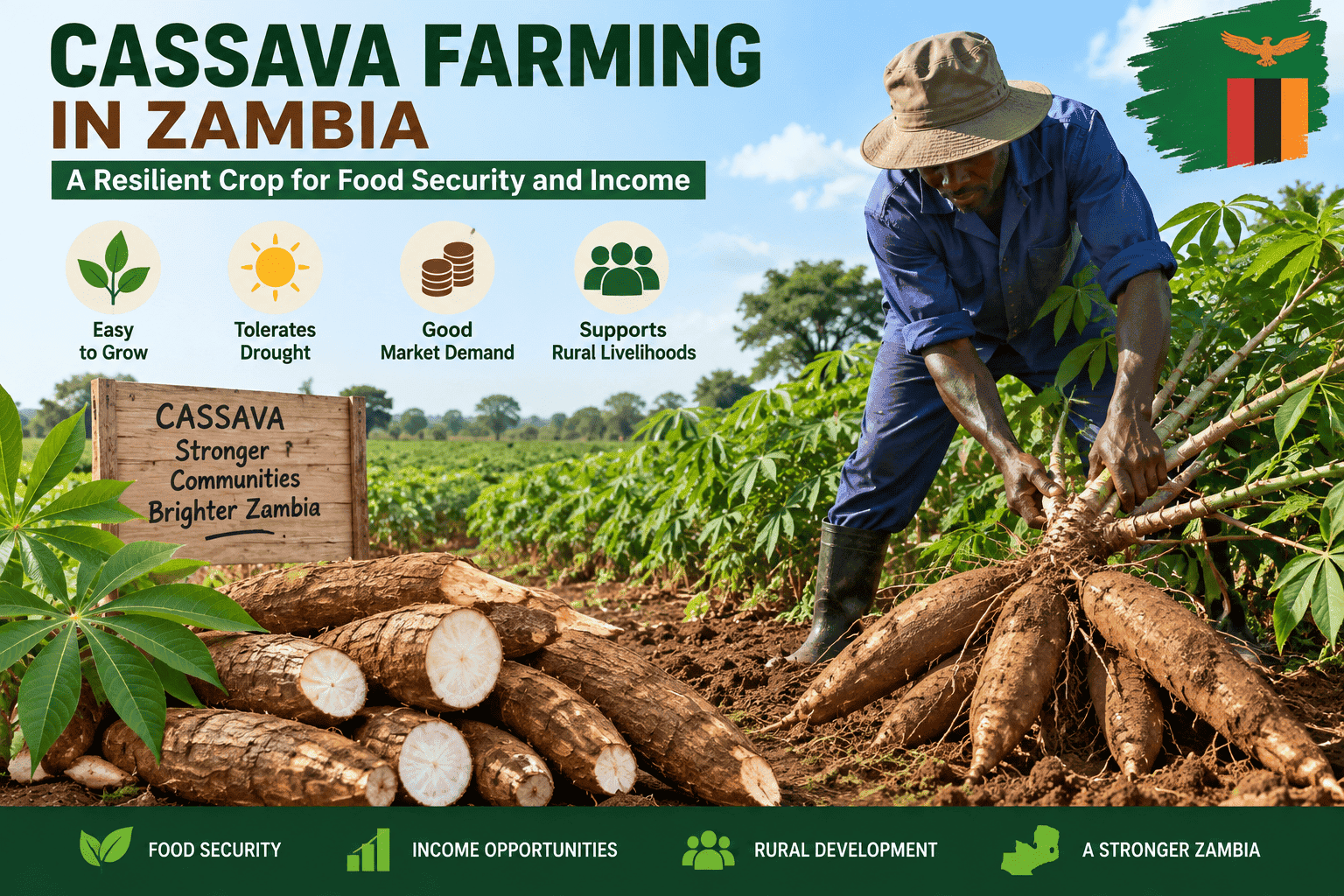
Cassava farming in Zambia is an important source of food and income for farmers, particularly in areas where rainfall conditions make growing crops such as maize more challenging. Cassava is relatively drought tolerant, can remain in the ground until it is needed, and can be grown for household consumption as well as commercial markets.
Cassava is one of the crops farmers can consider when exploring crop farming in Zambia for food production and commercial agriculture. Its ability to tolerate relatively dry conditions, remain in the ground until needed and supply several potential markets makes it particularly valuable to smallholder and commercial farmers.
This guide explains how to start cassava farming in Zambia, from preparing the land to selling the harvested crop.
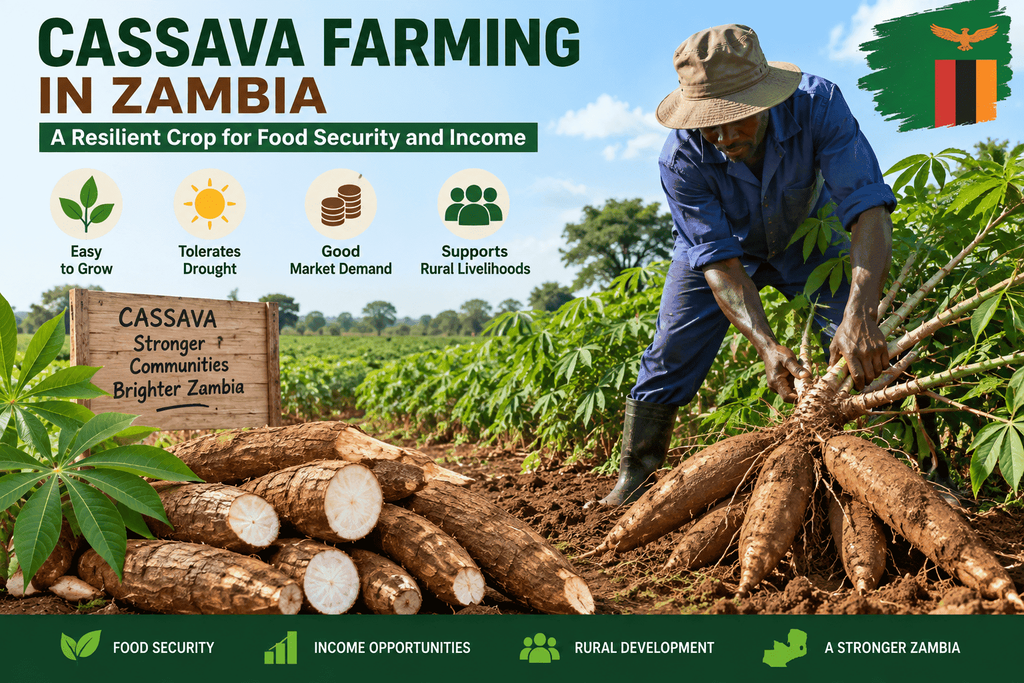
Why Grow Cassava in Zambia?
Cassava has several characteristics that make it attractive to Zambian farmers.
The crop can tolerate periods of low rainfall better than many common staple crops once it is established. It can also grow in a range of soil conditions, although good soil fertility and drainage generally produce better yields.
Another major advantage is its flexible harvesting period. Mature cassava roots can often be left underground for some time and harvested according to household needs or market demand.
Cassava also has several potential markets. Depending on location and variety, farmers can sell fresh roots, dried cassava chips, cassava flour or supply processors using cassava as an industrial raw material.
For smallholder farmers, this combination of food security and commercial potential makes cassava particularly useful.
Where Is Cassava Grown in Zambia?
Cassava is particularly important in northern and western parts of Zambia.
Production is associated with provinces including:
- Luapula
- Northern
- Muchinga
- North-Western
- Western
It can also be grown successfully in other parts of Zambia where suitable soil, rainfall and planting material are available.
Farmers should consider more than whether cassava can physically grow in their area. Commercial farmers should also investigate the location of potential buyers because transporting bulky fresh cassava roots over long distances can significantly increase production costs.
Climate Requirements for Cassava
Cassava performs well under warm tropical conditions.
It is known for its ability to withstand relatively dry conditions after establishment, but adequate moisture during the early stages of growth is important.
Newly planted cuttings require enough soil moisture to establish roots and shoots.
This is why rain-fed cassava is normally planted when reliable rains have started.
Although cassava is drought tolerant, this should not be interpreted to mean that drought has no effect on production. Extended moisture stress can reduce growth and ultimately lower yields.
Best Soil for Cassava Farming
Cassava can grow in different soils, but well-drained soils are preferable.
Deep, loose soils make it easier for storage roots to develop and expand.
Avoid fields that remain waterlogged for prolonged periods. Poor drainage can interfere with root development and contribute to root deterioration.
Before establishing a large commercial field, conducting a soil test can help determine soil fertility and whether amendments are required.
Land Preparation
Good land preparation creates favourable conditions for root development and makes subsequent field management easier.
Start by clearing excessive vegetation and removing obstacles that will interfere with planting.
Depending on the soil and farming system, cassava may be planted on:
- Flat land
- Ridges
- Mounds
Ridges or mounds can be particularly useful where drainage needs to be improved.
Commercial farmers using mechanisation can plough and harrow the field before planting.
The objective is to create a reasonably loose planting area without leaving severe compaction that could restrict root development.
Choosing Cassava Planting Material
Cassava is normally propagated using stem cuttings rather than seed.
The quality of these cuttings has a major influence on establishment.
Farmers should obtain planting material from healthy, mature plants and, wherever possible, use clean planting material from reliable sources.
Avoid stems showing obvious symptoms of disease or serious pest damage.
This is particularly important because infected planting material can introduce cassava diseases into a new field.
Farmers should seek varieties recommended for their production area through recognised agricultural research and extension channels.
Cassava Varieties in Zambia
The appropriate variety depends on location, intended market, disease resistance, maturity period and farmer preferences.
When selecting a cassava variety, consider:
Yield Potential
Higher-yielding varieties can improve production per hectare when properly managed.
Maturity Period
Some varieties mature earlier than others. Earlier maturity can allow farmers to reach the market sooner.
Disease Resistance
Disease resistance is especially important in areas affected by major cassava diseases.
Intended Market
A variety suitable for household consumption may not necessarily be the variety preferred by a commercial processor.
Before planting several hectares, identify what potential buyers actually require.
How to Prepare Cassava Cuttings
Planting material is normally taken from healthy cassava stems.
Cuttings should have enough viable nodes to establish successfully. Very immature, damaged or dried-out planting material should be avoided.
Where planting material must be transported, farmers should protect stems from excessive drying and physical damage.
Cuttings should ideally be prepared reasonably close to planting time.
Cassava Planting Spacing
A commonly used cassava spacing is approximately:
1 metre × 1 metre
At this spacing, a hectare can accommodate roughly:
10,000 cassava plants
The exact population will vary because of field layout, pathways, missing plants and the production system being used.
Spacing may also be adjusted depending on variety, soil fertility, intercropping and whether cassava is being grown primarily for root or planting-material production.
How to Plant Cassava
Cassava cuttings can be planted vertically, at an angle or horizontally depending on local practices and field conditions.
For many production systems, part of the cutting is inserted into the soil while enough of the stem remains appropriately positioned for shoot development.
The soil should make good contact with the cutting.
Poorly planted stems can dry out or establish unevenly.
After planting, inspect the field to identify cuttings that have failed to establish. Replanting missing stations early helps maintain the intended plant population.
When to Plant Cassava in Zambia
For rain-fed production, cassava should generally be planted after the rains have become established and there is sufficient soil moisture for the cuttings to develop.
Planting into dry soil can result in poor establishment.
The exact planting period varies between regions because Zambia’s rainfall patterns are not identical throughout the country.
Farmers should therefore base planting decisions on local rainfall conditions rather than relying only on a fixed calendar date.
Weed Control
Weed management is one of the most important operations during the early stages of cassava production.
Young cassava plants do not immediately form a dense canopy. Weeds can therefore compete strongly for sunlight, nutrients, moisture and space.
Keeping the field relatively weed-free while the cassava establishes can substantially improve crop performance.
Weed control methods include:
- Hand weeding
- Hoeing
- Mechanical cultivation
- Mulching
- Appropriate herbicide programmes
Once cassava develops a substantial canopy, shading can suppress some weed growth.
Do not wait until weeds completely dominate young cassava before controlling them.
Fertiliser and Soil Fertility
Cassava has a reputation for growing in relatively poor soils, but this does not mean soil fertility is irrelevant.
Every harvested crop removes nutrients from the field.
Repeated cassava production without adequate nutrient replacement can gradually reduce soil fertility and yields.
Farmers should consider soil testing before making major fertiliser decisions.
Organic materials such as well-decomposed manure can also contribute nutrients and improve soil properties where they are available.
For commercial production, fertiliser recommendations should ideally be based on soil conditions, yield targets and local agricultural advice rather than applying the same fertiliser programme to every farm.
Intercropping Cassava
Smallholder farmers frequently integrate cassava into diversified farming systems.
Cassava may be intercropped with crops such as legumes during the early stages of establishment.
Intercropping can help farmers obtain another crop from the same land before the cassava canopy closes.
However, excessive plant populations can create competition between crops.
The intercrop therefore needs appropriate spacing and management.
Major Cassava Diseases
Disease management begins with clean planting material.
Two important diseases that cassava farmers should understand are cassava mosaic disease and cassava brown streak disease.
Cassava Mosaic Disease
Cassava mosaic disease can cause distorted leaves, mosaic-like colour patterns and reduced plant growth.
Severely affected plants may produce substantially lower yields.
Using resistant or tolerant varieties and clean planting material is an important management strategy.
Cassava Brown Streak Disease
Cassava brown streak disease is particularly problematic because serious root damage can occur.
Symptoms can affect leaves, stems and roots, while root necrosis can make harvested cassava unsuitable for consumption or sale.
Farmers should avoid continuously recycling planting material from visibly diseased fields.
Cassava Pests
Cassava can also be attacked by various pests, including mites, mealybugs and other insects depending on location and growing conditions.
Regular field inspection is important.
Walk through the field periodically and look for unusual leaf damage, distorted growth, pest populations or disease symptoms.
Early identification makes it easier to obtain appropriate advice before a problem spreads across a large field.
How Long Does Cassava Take to Mature?
Cassava maturity varies according to variety, environment and production objectives.
Some varieties can be ready for harvesting considerably earlier than traditional late-maturing varieties, while others may remain in the field much longer.
A broad production period can extend from approximately 9 months to 18 months or longer, depending on the variety and intended use.
Farmers should therefore know the maturity characteristics of the specific variety they plant.
How to Harvest Cassava
Cassava harvesting involves removing the storage roots from the soil while minimising damage.
For small fields, harvesting is commonly performed manually.
The stem may first be cut back before the plant is pulled or the soil around the roots loosened.
Care is necessary because damaged roots deteriorate more rapidly.
Cassava has an important characteristic that every commercial farmer should understand:
Once harvested, fresh cassava roots are highly perishable.
This makes harvesting schedules and marketing closely connected.
Do not harvest a large quantity of fresh cassava without knowing where it will be sold, processed or stored appropriately.
Cassava Yield per Hectare in Zambia
Cassava yields vary enormously.
Variety, rainfall, soil fertility, plant population, disease pressure, weed management and harvesting age can all influence production.
A poorly managed field using unhealthy planting material may produce very low yields, while improved varieties under good management can produce substantially more.
For business planning, farmers should avoid building financial projections around the highest yield figures they encounter.
Use conservative yield assumptions and calculate what happens to profitability if actual production is below expectations.
Example Cassava Production Calculation
Suppose a farmer establishes one hectare using approximately 10,000 planting stations.
If establishment is 90%, the field would contain approximately:
10,000 × 90% = 9,000 established plants
Production then depends on the average marketable root yield achieved across the field.
For example, at an illustrative yield of 20 tonnes per hectare:
20 tonnes = 20,000 kg of cassava
If the farmer obtained an illustrative farm-gate price of ZMW 2.00 per kg:
20,000 kg × ZMW 2.00 = ZMW 40,000 gross revenue
This is only an example and not a current market-price quotation.
Actual prices can differ significantly by province, season, buyer, variety, quality, quantity and whether the cassava is sold fresh or processed.
Costs of Cassava Farming in Zambia
The cost of establishing one hectare depends heavily on whether the farmer uses family labour, hired labour or mechanised operations.
Typical expenses may include:
| Expense | What It Covers |
|---|---|
| Land preparation | Clearing, ploughing, ridging or mounding |
| Planting material | Cassava stems |
| Labour | Cutting preparation and planting |
| Weed management | Manual, mechanical or chemical control |
| Fertility management | Fertiliser, manure or soil amendments |
| Pest and disease management | Monitoring and approved control measures |
| Harvesting | Labour or machinery |
| Bags/handling | Preparing harvested crop for market |
| Transport | Moving cassava to buyers |
| Processing | Chipping, drying, milling or other value addition |
Rather than relying on a national “cost per hectare,” farmers should obtain prices from suppliers and labour providers in their own district.
Is Cassava Farming Profitable in Zambia?
Cassava farming in Zambia can be profitable when farmers combine reasonable yields with reliable markets and good cost control.
Profit can be estimated using:
Profit = Total Revenue − Total Production Costs
For example, if a farmer generates ZMW 60,000 in sales and spends ZMW 35,000 producing and marketing the crop:
ZMW 60,000 − ZMW 35,000 = ZMW 25,000
The estimated profit would be ZMW 25,000.
But profitability should not be judged using revenue alone.
Transport costs, labour requirements, post-harvest losses and market prices can dramatically affect the final result.
Finding a Market Before Planting
For anyone approaching cassava as a business, market research should happen before planting, not after harvesting.
Ask potential buyers:
- What cassava varieties do you buy?
- Do you purchase fresh or dried cassava?
- What quality standards do you require?
- What quantities can you accept?
- How frequently do you buy?
- Is pricing per kilogram, bag or tonne?
- Who pays transportation costs?
- Where is delivery made?
These questions can determine whether a cassava project that appears profitable on paper actually works commercially.
Cassava Markets in Zambia
Potential markets can include:
Local Fresh Markets
Fresh cassava can be sold directly to consumers, traders and local markets.
Cassava Flour
Cassava roots can be processed into flour for household and commercial uses.
Dried Cassava Chips
Drying extends shelf life and makes transportation and storage easier than fresh roots.
Livestock Feed
Cassava products can potentially form part of livestock-feed value chains when properly processed and formulated.
Industrial Processing
Cassava starch and related products have potential industrial applications.
Commercial farmers targeting processors should obtain buyer specifications before choosing a variety or establishing large acreages.
Adding Value to Cassava
Selling raw cassava roots is only one business model.
Value addition may allow farmers or cooperatives to participate further along the cassava value chain.
Potential products include:
- Dried cassava chips
- Cassava flour
- Cassava starch
- Packaged cassava products
- Processed livestock-feed ingredients
Processing introduces additional costs for equipment, energy, labour, packaging, food safety, quality control and marketing.
Farmers should therefore calculate whether the higher selling price actually produces a higher net profit.
Cassava Farming as a Business
A farmer planning commercial cassava production should think of the farm as a business from the beginning.
Keep records for:
- Planting material
- Labour
- Land preparation
- Fertiliser and manure
- Weed control
- Transport
- Harvest quantities
- Selling prices
- Buyer payments
- Total revenue
Without records, it is difficult to determine the actual cost of producing one kilogram or tonne of cassava.
Starting Small Before Expanding
New cassava farmers should consider beginning with a manageable area.
A smaller first crop provides an opportunity to understand local production conditions, test varieties and establish relationships with buyers.
Once the farmer has reliable planting material, production experience and a proven market, acreage can be increased.
Expanding from one successful hectare to five hectares is usually a stronger business strategy than planting five hectares without first confirming the market.
Common Cassava Farming Mistakes
Several mistakes can reduce the profitability of a cassava farm.
Using Diseased Planting Material
Cheap planting material can become expensive if it introduces disease into the field.
Poor Weed Control
Allowing weeds to dominate during establishment can substantially reduce crop performance.
Planting Without a Market
A large harvest becomes a problem when the farmer cannot sell or process it quickly.
Ignoring Transportation Costs
Fresh cassava is bulky. A distant market offering a higher price may actually be less profitable after transportation is included.
Assuming Cassava Needs No Fertility Management
Cassava can tolerate relatively difficult conditions, but continuous nutrient removal eventually affects soil productivity.
Expanding Too Quickly
Large acreage increases labour, planting-material, harvesting and marketing requirements.
Simple Cassava Farming Plan for One Hectare
A first-time commercial farmer could approach the project in stages.
Step 1: Identify potential cassava buyers.
Step 2: Select a suitable field.
Step 3: Obtain information on recommended varieties for the area.
Step 4: Source healthy planting material.
Step 5: Prepare approximately one hectare.
Step 6: Plant at the beginning of suitable moisture conditions.
Step 7: Replace failed plants early.
Step 8: Maintain strict early weed control.
Step 9: Monitor pests and diseases throughout production.
Step 10: Confirm buyers again before harvesting.
Step 11: Harvest according to market requirements.
Step 12: Record yield, revenue and all production costs.
The results from the first crop can then be used to determine whether expanding production is financially justified.
Frequently Asked Questions
Is cassava farming profitable in Zambia?
Cassava farming in Zambia can be profitable when farmers achieve good yields, control production costs and have reliable buyers. Profitability varies considerably according to location, yield, market price, transportation distance and whether the crop is sold fresh or processed.
How many cassava plants can I plant on one hectare?
How many cassava plants you can plant on one hectare depends on spacing. At approximately 1 metre × 1 metre spacing, the theoretical population is about 10,000 plants per hectare, although actual field populations can differ.
How long does cassava take to mature in Zambia?
How long cassava takes to mature in Zambia depends mainly on variety, environmental conditions and intended use. Some improved varieties may be harvested earlier, while other varieties can remain in the field for considerably longer.
When should I plant cassava in Zambia?
When you should plant cassava in Zambia depends on local rainfall conditions. For rain-fed production, planting is generally done when reliable rains have provided sufficient soil moisture for stem cuttings to establish.
Which province produces cassava in Zambia?
Which province produces cassava in Zambia does not have a single answer because cassava is grown across several provinces. It is particularly important in areas including Luapula, Northern, Muchinga, North-Western and Western provinces.
How much cassava can I harvest from one hectare?
How much cassava you can harvest from one hectare varies considerably according to variety, plant population, rainfall, soil fertility, weed control, disease pressure and management. Farmers preparing a business plan should use conservative local yield estimates rather than assuming maximum experimental yields.
Where can I sell cassava in Zambia?
Where you can sell cassava in Zambia depends on your location and product. Potential buyers include consumers, market traders, processors and businesses purchasing cassava for flour, dried chips, starch or other products. Commercial farmers should identify buyers before planting.
Final Thoughts
Cassava farming in Zambia offers opportunities for both food production and commercial agriculture. Its drought tolerance, flexible harvesting period and range of possible uses make it particularly valuable in farming systems where resilience is important.
But cassava should not be treated as a crop that can simply be planted and forgotten.
Healthy planting material, appropriate varieties, good early weed control, soil fertility management, disease monitoring and reliable markets all contribute to successful production.
For a new commercial farmer, the strongest approach is to find the market first, start at a manageable scale, keep detailed production records and expand only after proving the economics of the crop.