
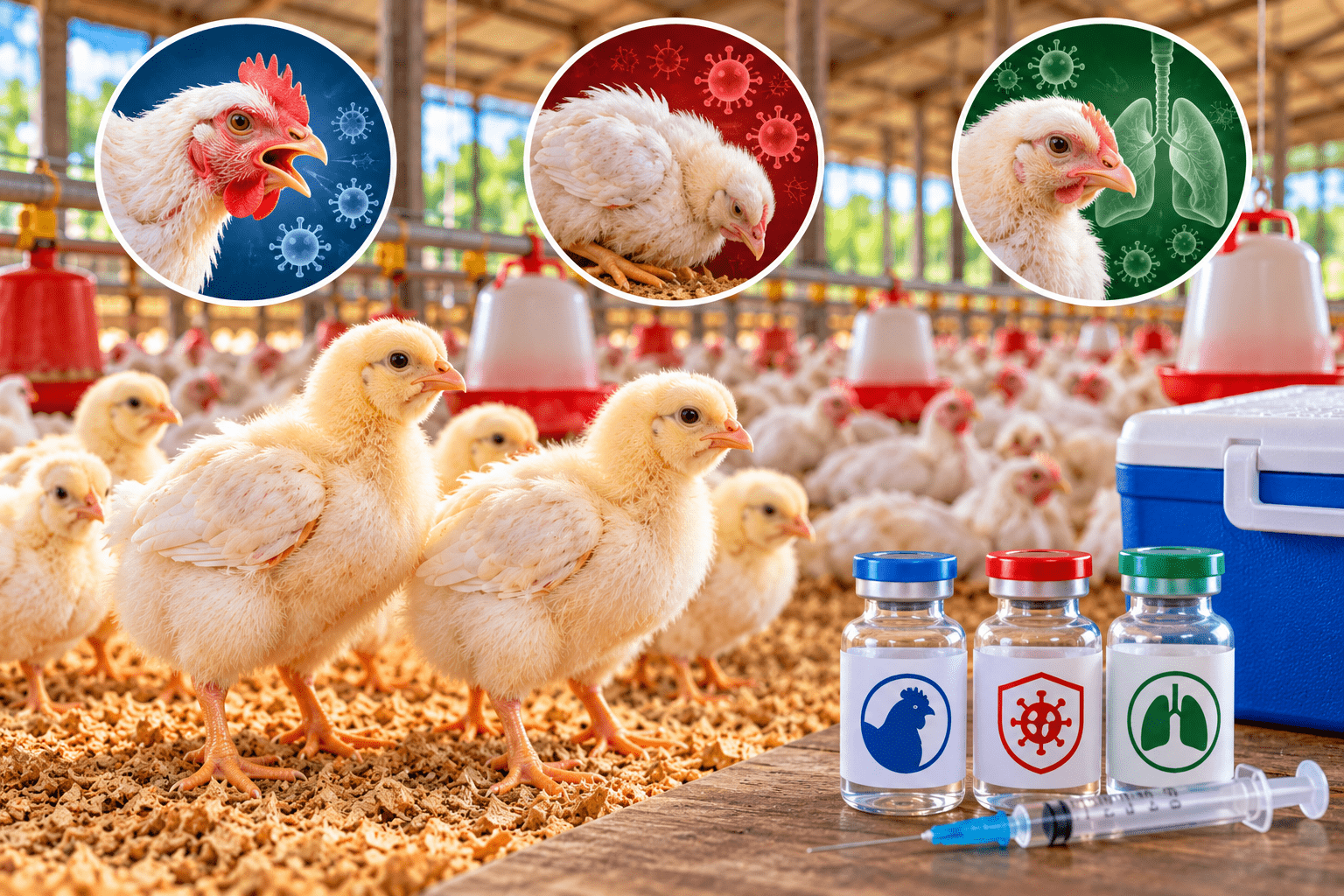
Broiler chicken vaccines in Zambia help protect flocks against serious poultry diseases that can cause sudden mortality, poor growth and major financial losses. Because broilers are usually raised for a relatively short production cycle, vaccination programmes tend to focus on fast-moving viral diseases such as Newcastle Disease, Gumboro or Infectious Bursal Disease, and Infectious Bronchitis.
Vaccination should always be combined with good brooding, clean water, quality feed, proper ventilation and strong biosecurity. For the complete production process, see our Broiler Chicken Rearing in Zambia guide. You can also read our broader Poultry Farming in Zambia pillar for information on other poultry enterprises.
Why Vaccination Matters in Broiler Farming
Disease control is especially important because broiler production is already a substantial part of Zambia’s poultry sector.
According to the Zambia Statistics Agency’s 2023 Livestock Survey Report, Zambia had approximately 5.33 million broiler chickens as at 30 April 2023. About 4.38 million were raised by households, while roughly 945,000 were raised by agricultural establishments. Lusaka Province accounted for the largest share of the national broiler population, followed by Copperbelt Province.
The same survey was jointly produced by the Zambia Statistics Agency and the Ministry of Fisheries and Livestock, making it one of the strongest official sources for current livestock and poultry statistics in Zambia.
With millions of broilers being raised across Zambia, outbreaks of diseases such as Newcastle Disease and Gumboro can have serious consequences for individual farmers and the wider poultry industry. Vaccination should therefore form part of a broader disease-prevention programme that also includes good hygiene, clean water, ventilation, proper nutrition and strong biosecurity.
Main Diseases Vaccinated Against in Broilers
Newcastle Disease
Newcastle Disease is a highly contagious viral disease that can spread quickly through a poultry flock.
Possible signs include:
- coughing or difficulty breathing;
- greenish diarrhoea;
- weakness;
- nervous signs such as twisted necks;
- paralysis; and
- sudden mortality.
The Zambian Ministry of Agriculture describes Newcastle Disease as a serious poultry disease and identifies vaccination, hygiene and biosecurity as key preventive measures.
Gumboro Disease
Gumboro is also known as Infectious Bursal Disease or IBD.
It mainly affects young chickens and damages the Bursa of Fabricius, an organ involved in development of the immune system.
Affected birds may show:
- depression;
- ruffled feathers;
- watery diarrhoea;
- loss of appetite;
- weakness; and
- increased mortality.
Even birds that survive can suffer immune suppression, leaving them more vulnerable to secondary infections.
Infectious Bronchitis
Infectious Bronchitis is another contagious viral disease affecting chickens.
Possible signs include:
- coughing;
- sneezing;
- nasal discharge;
- noisy breathing;
- reduced feed intake; and
- poor growth.
Some hatcheries may include Infectious Bronchitis vaccination in their day-old chick programme.
Example Broiler Vaccination Schedule
There is no single broiler vaccination schedule that every farmer in Zambia should follow automatically.
The correct programme depends on:
- vaccines already administered at the hatchery;
- chick source;
- maternal antibody levels;
- local disease pressure;
- vaccine type;
- farm history; and
- veterinary advice.
A programme may look broadly like this:
| Age | Possible vaccine | Disease |
|---|---|---|
| Day 1 | Newcastle + Infectious Bronchitis or other hatchery vaccines | ND and IB |
| Day 7–10 | Gumboro first dose | IBD |
| Around Day 14 | Newcastle booster | ND |
| Day 18–21 | Gumboro booster where required | IBD |
| Day 24–28 | Newcastle booster where required | ND |
This is only an illustrative schedule, not a prescription.
One of Zambia’s major chick suppliers, Hybrid Poultry Farm, states that its day-old chicks are immunised against common poultry diseases including Newcastle and Gumboro. This is a good example of why farmers should verify what has already been given before administering additional vaccines.
Always Check the Hatchery Vaccination Record
Before collecting or receiving your broiler chicks, ask:
Which vaccines have these chicks already received?
Do not assume the chicks are completely unvaccinated.
The supplier should ideally tell you:
- vaccines given;
- date administered;
- method used;
- recommended boosters; and
- suggested timing for the next vaccination.
This helps prevent unnecessary duplication.
How Broiler Vaccines Are Administered
Depending on the vaccine, broiler vaccines may be administered through:
- drinking water;
- eye drops;
- spray;
- injection; or
- hatchery application.
Drinking-water vaccination is common because it allows a large flock to be vaccinated relatively quickly.
However, not every vaccine is suitable for drinking-water administration.
Always follow the product instructions.
Giving Vaccines Through Drinking Water
Where the manufacturer’s instructions specify drinking-water administration, preparation must be done carefully.
A typical process involves:
- Clean the drinkers thoroughly.
- Avoid disinfectant or chlorine residues where these could inactivate a live vaccine.
- Prepare clean water according to the vaccine instructions.
- Where recommended, briefly withhold water beforehand so birds drink promptly.
- Mix only the quantity of vaccine solution the flock can consume within the recommended period.
- Distribute the solution evenly throughout the house.
- Make sure weaker birds also have access to drinkers.
- Discard unused vaccine solution safely.
Do not use a fixed water-withdrawal period under all conditions.
On very hot days, excessive water deprivation can place unnecessary stress on broilers. Follow the vaccine manufacturer’s guidance and adjust management to environmental conditions.
Be Careful With Chlorinated Water
Live vaccines can be damaged by disinfectants and chlorine.
Farmers using treated municipal water therefore need to follow the vaccine manufacturer’s instructions carefully.
Some vaccination programmes use a recognised vaccine stabiliser or suitable skimmed milk product to protect live vaccine organisms in drinking water.
However, the correct product and quantity should come from the vaccine label, manufacturer or veterinary adviser, rather than using the same mixture for every vaccine.
Maintain the Vaccine Cold Chain
Vaccines are sensitive biological products.
From purchase until administration, they should be transported and stored according to the manufacturer’s required temperature range.
For many poultry vaccines, this involves refrigeration.
When collecting vaccines from an agrovet or veterinary supplier:
- use a cooler box where appropriate;
- use suitable ice packs;
- protect the vaccine from direct sunlight;
- do not leave it in a hot vehicle; and
- return it to appropriate refrigeration promptly.
The Ministry of Agriculture also advises poultry farmers to keep Newcastle vaccines refrigerated, check expiry dates and follow the manufacturer’s instructions.
A cold-chain failure may reduce vaccine effectiveness even when the vial appears normal.
Vaccinate During Cooler Conditions Where Practical
Where possible, vaccination can be easier during cooler parts of the day, particularly in hot weather.
Excessive heat can stress broilers and may affect how evenly they drink.
Early morning is therefore often a practical time for drinking-water vaccination.
The most important consideration is that birds are healthy, the vaccine is handled correctly and all birds receive an effective dose.
Do Not Vaccinate Sick Birds Without Veterinary Advice
Vaccines are designed to stimulate immunity in healthy birds.
Birds that are already:
- seriously sick;
- dehydrated;
- severely heat stressed;
- badly underfed; or
- suffering another major disease challenge
may not respond properly.
The Ministry of Agriculture advises against vaccinating chickens already showing signs of illness during a Newcastle outbreak and recommends contacting veterinary personnel when disease is suspected.
Vaccination should not be treated as a cure after an outbreak has already begun.
Common Causes of Vaccine Failure
A vaccinated flock can still experience disease when the vaccination programme is poorly implemented.
Common causes include:
Cold Chain Breakdown
Excessive heat during storage or transport can reduce the effectiveness of live vaccines.
This risk deserves particular attention where vaccines are transported long distances or electricity supply is unreliable.
Chlorine or Disinfectant Residues
Live vaccine organisms may be damaged by chlorine or disinfectant remaining in water or drinkers.
Incorrect Timing
Vaccination that is too early or too late can reduce protection.
Maternal antibodies can sometimes interfere with certain vaccines when administered too early.
Poor Distribution
If some birds consume most of the vaccine water while others receive little or none, flock immunity can become uneven.
Vaccinating Sick Birds
Birds already fighting serious disease may respond poorly to vaccination.
Expired Vaccines
Always check the expiry date before administration.
Biosecurity Is Just as Important as Vaccination
Vaccination provides immune protection, but biosecurity helps prevent disease organisms from entering the poultry house.
Useful measures include:
- restricting visitors;
- using dedicated poultry-house footwear;
- placing properly maintained footbaths at entrances;
- cleaning feeders and drinkers;
- controlling rodents;
- keeping wild birds away from the flock;
- avoiding unnecessary sharing of equipment between farms; and
- removing sick or dead birds promptly.
A heavily contaminated poultry house can still experience serious disease problems even when vaccines have been administered.
Clean Between Broiler Batches
After selling a broiler flock:
- remove the old litter;
- clean feeders and drinkers;
- wash the poultry house;
- disinfect surfaces;
- control rodents and insects; and
- allow adequate downtime before placing the next flock.
The exact downtime should depend on farm conditions, disease history and veterinary advice rather than relying on one fixed number of days for every farm.
Keep Proper Vaccination Records
Every broiler farmer should keep a vaccination record.
A simple record can include:
| Record | Details |
|---|---|
| Chick arrival date | Date |
| Number of chicks | Flock size |
| Chick supplier | Hatchery |
| Vaccine | Vaccine name |
| Disease | ND, IBD, IB, etc. |
| Vaccination date | Date |
| Method | Water, spray, eye drop |
| Vaccine batch | Batch number |
| Expiry date | Date |
| Mortality | Daily record |
Good records can help identify problems when mortality or poor flock performance occurs.
Where to Get Broiler Vaccination Advice in Zambia
The safest approach is to combine information from your chick supplier with advice from a qualified Veterinary Officer or livestock professional.
Farmers can also use guidance from the Zambian Ministry of Agriculture on Newcastle Disease prevention and poultry health.
Major poultry suppliers such as Hybrid Poultry Farm also provide technical support, flock-management materials and poultry-health information for farmers in Zambia.
Final Thoughts
Broiler chicken vaccines in Zambia are an essential part of protecting birds against diseases such as Newcastle Disease, Gumboro and Infectious Bronchitis.
The most important mistake to avoid is copying a vaccination schedule without first checking what the hatchery has already administered.
A good approach is to:
- confirm the chick vaccination history;
- use an appropriate farm vaccination programme;
- maintain the cold chain;
- follow vaccine instructions carefully;
- vaccinate healthy birds;
- keep proper records; and
- combine vaccination with strong biosecurity.
Vaccines protect your investment, but they work best as part of an overall flock-health programme rather than as a substitute for good management.
For the complete growing programme, feeding, housing, stocking and marketing process, see our Broiler Chicken Farming in Zambia guide. You can also return to our broader Poultry Farming in Zambia pillar for more poultry-production guides.