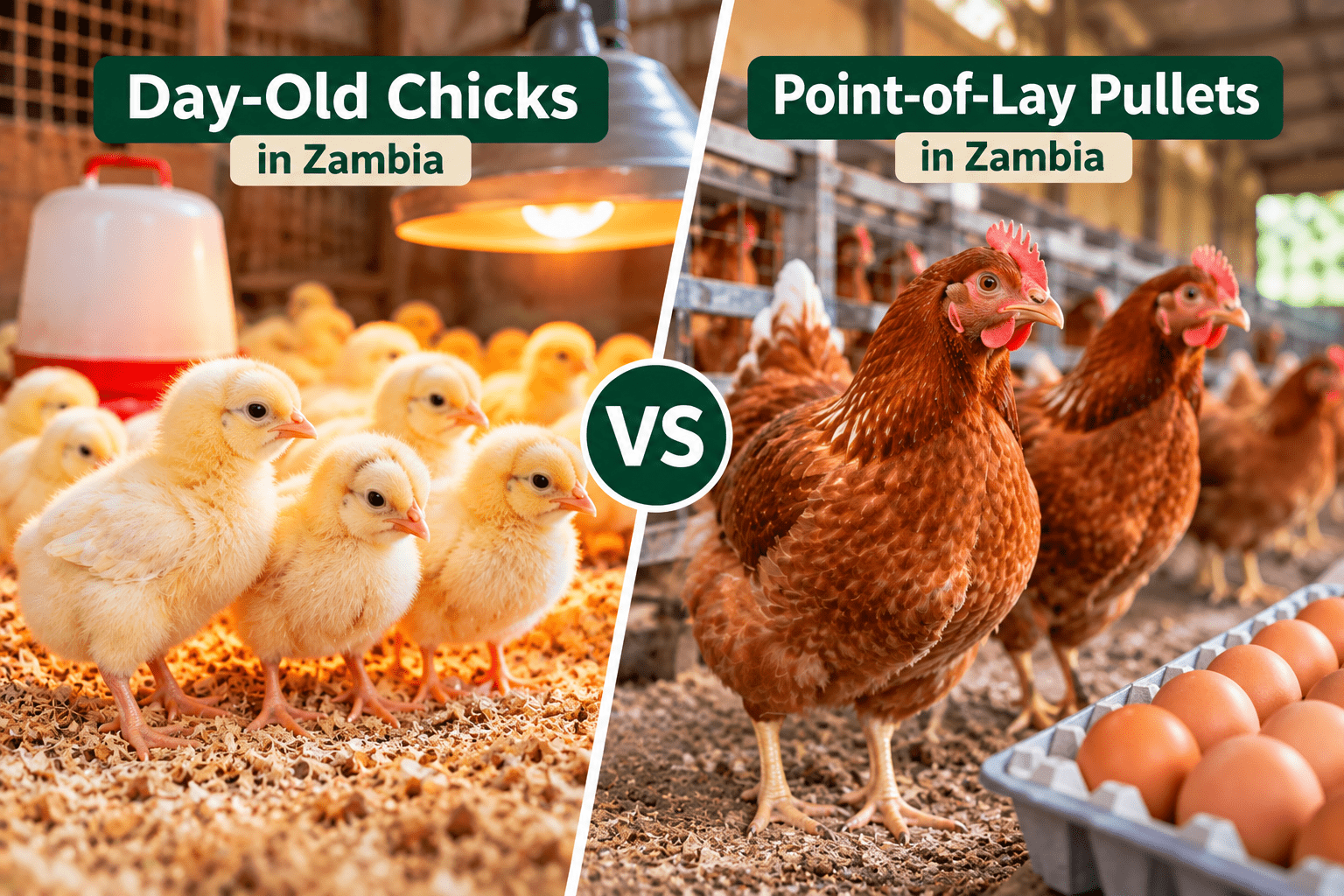
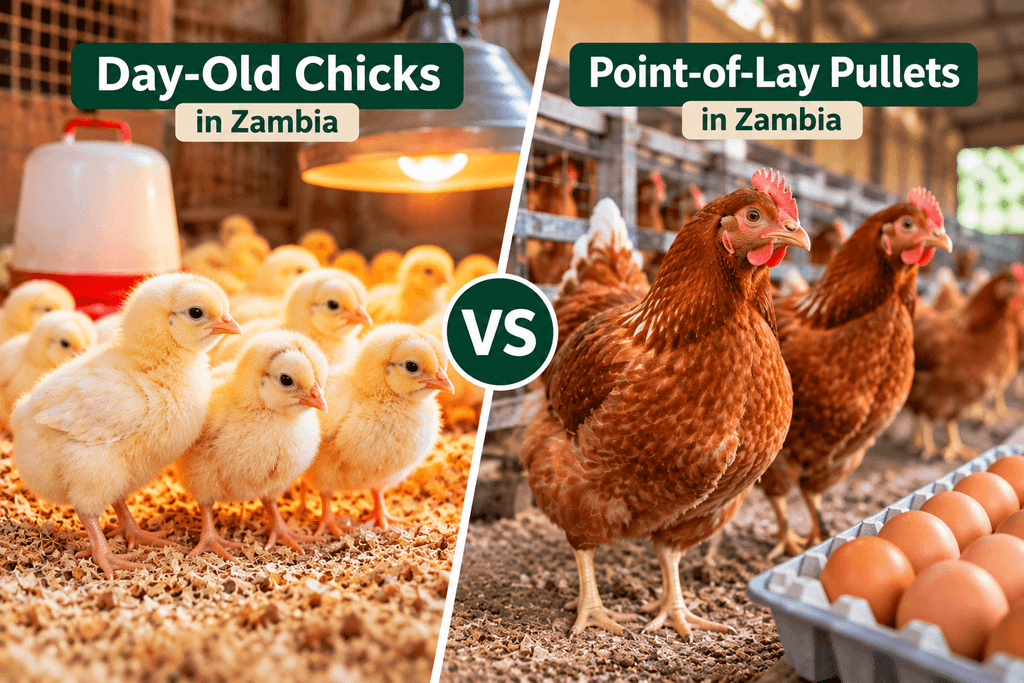
Day-old chicks vs point-of-lay pullets in Zambia is an important decision for anyone starting a layer chicken business. Day-old chicks cost less to buy, but they require brooding, vaccination, feeding and several months of rearing before they begin producing eggs. Point-of-lay pullets cost more upfront but allow a farmer to move into egg production much sooner.
If you are still planning your farm, see our main guide on How to Start Layer Chicken Farming in Zambia. You can also read our broader Poultry Farming in Zambia guide for information on poultry housing, feeding, health management and other poultry enterprises.
What Are Day-Old Layer Chicks?
Day-old layer chicks are newly hatched female chicks bred for egg production.
When you buy them, you take responsibility for raising them from the brooding stage until they become productive laying hens.
This means providing:
- heating during brooding;
- starter and grower feed;
- clean drinking water;
- vaccinations;
- suitable housing;
- biosecurity; and
- regular monitoring.
Most commercial layer birds begin approaching egg production at roughly four to five months of age, although the exact timing depends on the breed, feeding programme and management.
What Are Point-of-Lay Pullets?
Point-of-lay pullets are young female chickens that have already passed through most of the growing period and are approaching egg-producing age.
The supplier has therefore already carried much of the cost and risk associated with:
- brooding;
- feeding;
- vaccination;
- mortality;
- labour; and
- growing the birds to maturity.
That is why point-of-lay pullets normally cost much more than day-old chicks.
Main Differences
| Factor | Day-old chicks | Point-of-lay pullets |
|---|---|---|
| Purchase cost | Lower | Higher |
| Brooding required | Yes | No |
| Time before eggs | About 4–5 months | Much shorter |
| Management demands | Higher | Lower initially |
| Early mortality risk | Farmer carries it | Much of it already passed |
| Control over rearing | High | Depends on supplier |
| Initial capital | Lower | Higher |
| Feed before egg income | Much more | Much less |
Advantages of Starting With Day-Old Chicks
Day-old chicks may make sense when you have experience with brooding and enough working capital to raise the birds properly.
The main advantages are:
- lower purchase price;
- greater control over vaccination and feeding;
- ability to monitor flock development from the beginning; and
- potentially lower cost per mature bird if your rearing system is efficient.
The disadvantage is that the birds consume feed for several months before producing eggs.
That period must be properly financed.
Advantages of Point-of-Lay Pullets
Point-of-lay pullets allow farmers to enter the egg-production stage much sooner.
They may be particularly attractive if you:
- are new to brooding;
- do not have chick-heating equipment;
- want to start producing eggs sooner; or
- want to avoid most of the early chick-rearing period.
The trade-off is the much higher purchase price.
You are effectively paying for both the bird and the work that has already gone into raising it.
Don’t Compare Purchase Prices Alone
The price of a day-old chick should not be compared directly with the price of a point-of-lay pullet.
A better comparison is:
Cost of purchasing one point-of-lay pullet
versus
Total cost of raising one day-old chick until point of lay
For day-old chicks, include:
- feed;
- heating;
- vaccines;
- litter;
- water;
- electricity;
- labour; and
- mortality losses.
This gives a much more realistic picture of the true cost.
Which Is Better for a Beginner?
Point-of-lay pullets can simplify layer farming for beginners because they remove the brooding stage and shorten the period before egg production begins.
However, they are only a good option if they come from a reliable supplier.
Before buying, ask for information about:
- the birds’ age;
- breed or strain;
- vaccination history;
- feeding programme;
- health history; and
- source of the flock.
A bird being advertised as “point of lay” does not automatically mean it has been reared properly.
When Day-Old Chicks Make More Sense
Day-old chicks may be a better option when you:
- understand brooding;
- have reliable heating;
- have suitable chick housing;
- can finance several months of feed;
- can follow a proper vaccination programme; and
- want full control over the flock from the beginning.
Experienced farmers may also prefer raising their own pullets because they know exactly how the birds have been managed.
Zambia’s Layer Industry Is Already Significant
Layer production is an established part of Zambia’s poultry industry.
The Zambia Statistics Agency’s 2024 Integrated Agricultural Survey estimated that Zambia had approximately 2.21 million layer chickens across households and agricultural establishments. Lusaka Province recorded the largest layer population among surveyed households.
Farmers can consult the official Zambia Statistics Agency agricultural survey results for wider information on Zambia’s poultry and livestock sector. Zambia Statistics Agency – 2024 Integrated Agricultural Survey
These numbers show that anyone entering commercial egg production is joining an already established market, which makes proper planning, cost control and market identification important.
Which Should You Choose?
Choose day-old chicks when you have the skills, equipment and working capital to raise them properly.
Choose point-of-lay pullets when you want to move towards egg production more quickly and have enough capital to buy healthy birds from a trustworthy supplier.
For many first-time layer farmers, point-of-lay birds can simplify the start of the business. For experienced poultry farmers with good brooding facilities, raising day-old chicks can provide greater control over flock development.
Final Thoughts
The choice between day-old chicks and point-of-lay pullets in Zambia should be based on your capital, experience, facilities and how quickly you want egg production to begin.
Day-old chicks cost less initially but require more management and several months of feeding before producing eggs. Point-of-lay pullets cost more upfront but shorten the waiting period before production.
For the full process of establishing an egg-production business, continue with our main guide on How to Start Layer Chicken Farming in Zambia. For broader information on poultry production, see Poultry Farming in Zambia.